Wednesday, May 25, 2016

"TAKE ME OUT TO THE BALLGAME"


Can this be true ?  The Red Sox as of today are in first place in their division?  Oh, well, too early to get excited about their prospects. . . too much Red Sox history of disappointments.  I was bitten by the Red Sox 'bug' many years ago when a student at Boston University, having cut a class in Church History to see Ted Williams in his next to last game.  Now with three World Series Championships within the past 12 years a bit of the historic pain has been assuaged.

In the meantime, there is baseball at a different level and there are those who would maintain "at a purer level", i.e., the Minor Leagues and various categories of the 'non-professional', those who play it for the sheer fun .
In the late 1980's my cousin, Tommy,  pitched for a minor league affiliate of the New York Mets.  HIs team occasionally played in the city where I then lived and he would always provide complimentary tickets.  On one occasion, he was the winning pitcher in a game there and I realized that despite my love of the  game this was likely the only  time that I would see the family name in scoreboard lights.


"If they don't win, it's a shame . . ."

When a child, my grand-son Taylor enjoyed singing, "Let me   woot, woot, woot, for the home team. . ."
A few weeks ago, along with colleagues and friends, I attended a game of the local Class A-Advanced affiliate of the Chicago White Sox.  It was fun to watch the home runs but they lost.  Nearby, the Single A affiliate of the Miami Marlins has consistently provided good baseball and good entertainment.  Recently, Miss Babe Ruth retired after several years of retrieving bats, delivering balls to umpires, and playing post-game 'fetch'.  A black Lab Retriever, she has been succeeded by her brother, Master Yogi Berra, and niece, Miss LouLou Gehrig.  (Check her out on You Tube.)

"The moment of Truth . . . "

When it comes to athletic "heroes", I prefer to find mine on a more local level.  Four of my wife's grand-nephews play on  county recreation league teams and we anticipate attending their upcoming games.  Ten year old Ian who views us as surrogate grand-parents is developing into a very talented baseball player, equally adept as pitcher, catcher, shortstop and hitter.  Last week-end he had his first ever over the fence home run, having hit an 'in the park' home run the week-end previously.
Ian steals home


My late Uncle Ken was an overpowering pitcher in his youth.
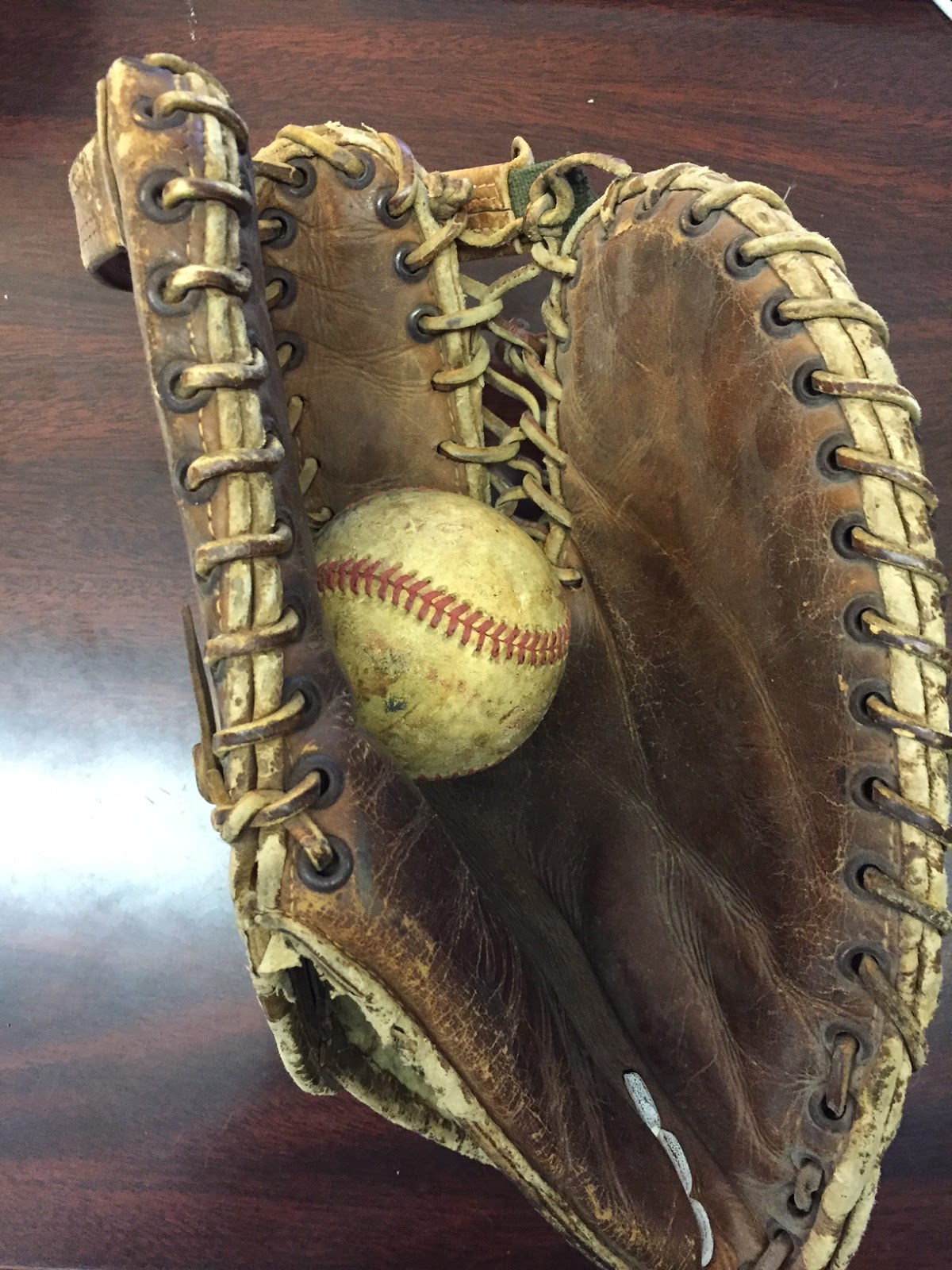
Having played in the minors, he acknowledged in his later years that every Spring, he 'got the itch', meaning he would have relished the opportunity play once again.  I never progressed beyond high school athletics but I played first base well enough to enjoy the games.  Like Uncle Ken, I still 'get the itch' at this time of the year.
"Once upon my time . . ."

"Play Ball"

Satchel


Friday, May 6, 2016

'"SHOESHINE, MISTER?"


   This shoe shine box was my "office" as I made my first foray into entrepreneurship.  Our dad had built it in high school shop class many years earlier.  My brother and I guess it to be about 90 years old now.

      Throughout his life dad always maintained a high gloss on his 'dress shoes'.  He often admonished his sons that regardless of how well- dressed someone might be, if the shoes were scuffed and dirty, well... they just were not actually well-dressed.  As I write this, I touch memories of Saturday night shoe shines as we prepared for next day's church attendance. My almost 68 year old 'baby brother' maintains that he used it when shining his older brothers' shoes for their high school dates.

     Back to the entrepreneur-ing.  Around the age of  ten or eleven, wanting to earn additional money, I applied for the job of  shoe shiner at Mr. Lewter's barbershop.  (In our area at that time, barbershops had a virtual monopoly as the place to receive such service.)  Mr. Lewter  told me that Charles G. currently had the job but had not been there for several weeks. (The 'work week' was Friday afternoon after school and all day on Saturdays.)  Then he added that if Charles did not come in 'tomorrow' ...Saturday... , I could have the job.  I asked if I could stay and shine shoes that day for any customers that might want that. 'Yes'.  Well,  I had a few customers.  Charles apparently learned of all that and came to the shop the following morning.  Whereupon, I took the above box, well stocked with tools of the trade, and set up my business across the street in front of the dry cleaning plant owned by dad and my uncle.  Unlike Charles's experience that day, my business 'boomed' and by the end of the day, he 'resigned'.  The following week, I was in my new 'office' and remained there until I was hired to work in the new 'supermarket' that came to town.


    Unlike the Chattanooga Shoe Shine Boy (of the song by that title) who "charges you a nickel just to shine one shoe", I remember my fee being 25 cents.  Mr. Lewter provided the space free, so on a given week-end I could earn a respectable income.  I suppose his rationale --beyond his kindness to an enterprising kid -- was that having a shoe shiner in his shop was also 'good for business'.  It has been a long time  since I had a professional shoe shine and have no idea the current cost but likely it is in the range of what an inexpensive pair of shoes might have cost in the late 1940's.

   When Mr. Lewter moved his shop to a more spacious locale, I also had a larger 'office'.  Only once did I have an unpleasant customer experience.  On a rainy Saturday, Charlie Gray, a local 'jack-leg preacher' (according to the Oxford English Dictionary:
 "incompetent, unskilled, unscrupulous, dishonest. Frequently used of lawyers and preachers.") asked that I shine his shoes.  When I had finished, this physically large man said, "Son, it's raining outside. You don't want to charge me a quarter, do you?"  He gave me 15 cents. I felt intimidated, by his being an 'adult' and by his size. Today, we might call this behavior 'bullying'. I prefer 'grandiose'.  This same man said to dad, the dry cleaner, that since  he (Charlie) was a minister, dad ought to give him a reduced rate for cleaning his clothing.  Whereupon dad ended that claim of specialness by informing Charlie that it cost dad as much to clean his clothes as it did anyone else's.

    A few years later, when our family moved to a new town and dad began his career with Metropolitan Insurance Company, my brother launched his own  'business career' shining shoes in our uncle's shop in the nearby mill town.  He claims little remembrance of that time other than the shop's lack of indoor plumbing, necessitating considerable resourcefulness in seeking alternatives.  

    The Chattanooga Shoe Shine Artist allegedly could also 'make the oldest kind  o' leather look like new' through his virtuosity in snapping the cloth.  I never reached that level of artistry but I developed sufficient skills so that when I was a lowly army private, I could put an impressive 'spit shine' on my boots.  Only rarely, when in a rush, did I fall back on the prevailing trick of using a commercial brand deodorant pad that could produce a shine wherein you could see your face well enough to shave . . .  provided no water hit them and the sergeant was in sufficient hurry not to look too  closely.

    Wow ! If I had known that trick years earlier, I could have given Charlie his 'money's worth'.
       
    Satchel


Saturday, April 9, 2016

MY GRAND-FATHER'S CLOCK


          "Mamma, Grand-pa  spanked me !" , I lamented, expecting consolation.
       Instead :"He told you to stop messing with the clock."

      Lest this sound like an acknowledgement of long-ago child abuse, perhaps a bit of context is in order.  

     My grand-parents had the above clock on the mantel of their dining room.  When I was 4 or 5  years old, the clock and its pendulum fascinated my youthful curiosity.  So, on one of our visits, when I thought the adults were occupied in another room, I relocated a chair to the mantel, opened the clock door and began to accelerate the movement of the pendulum.  That was great fun until the clock's proprietor happened to walk through the room and observed my game.  I complied with his instruction to come down and desist.  When I thought he had returned to the living room, I resumed my fun.  Suddenly, there he was again, reminding me of his earlier admonition.  Then followed some kind of corporeal 'stimulation' to the posterior.  Retrospectively, I doubt that there were many licks with any force.  Likely, the hurt was to my feelings that I, the eldest grand-son, would be so disciplined.  Never again did I "mess with the clock", however.


Grover and Verdona Cooper
Clock owners
Late 1940's


Early in their marriage


    Then in 1951, just after my 13th birthday,  both grand-parents died within a month. The siblings made the sorrowful distribution of their parents' worldly possessions.  I lobbied the adults for the clock, using the rationale that I somehow 'deserved' it because of my earlier 'trauma' (though I did not know that word).  Instead it went to my Aunt Rachel, their youngest child,  ten years older than I.  Intermittently over the 65 years since then, I told Rachel that if she ever chose to dispose of the clock that I wanted to renew my bid.  Though I have frequently admired it, I knew that there were valid reasons it could not be mine.  Until this past Thursday night . . . 
Rachel, The Clock and Me,  April 7, 2016

       My two brothers and wives and I had visited her, gone to dinner and then back to her home for lots of warm conversation.  Rachel is 88 years old and a 'Karakter' and Family Treasure unto herself.  Still she posed a challenge to our decorum with her pre-meal grace: "Lord, Bless these Nephews and Neices and help them to behave."

    Back at her house, midway through the conversation, she suddenly said , "I have something I want to give Ron [me]" and disappeared into her kitchen. She returned with the clock and told us that her children had agreed that I could have it.  Seldom am I at a loss for words but in this moment, I could only manage , "Thank you !"  Gratefully, my sister-in-law, Shirley, had the presence of mind to record the moment.

      Then came an unknown piece of family lore.  She told us that her parents had received the clock from her paternal grand-parents.  She was uncertain as to whether it had been as a wedding gift (they were married in the early 1900's) or upon the occasion of her grand-parents' deaths.  At any rate, it is OLD.  And, it keeps perfect time, striking the half hour and hours.  (I attempted to insert a video of the striking.  Guess that's a tekky challenge for another time.  But then, the original owners didn't have computers and video. )


       I removed the current 'read' from the chest in order to take the above picture. Later, I thought it how appropriate to have left it there. The title: The Time of Our Lives.

    Satchel


Saturday, April 2, 2016

NOT A JOKE . . .


             Initially, I thought it a bad April Fool's joke when I read about it yesterday.  Then I learned that it was for real.  There is apparently a Bill pending in the Tennessee State Legislature that would allow mental health counselors to refuse to treat persons with belief systems different from their own.

     One Tennessee legislator reportedly told a television station that "the bill is aiming to reinforce the First Amendment by protecting the religious rights of counselors, allowing them to refer a patient elsewhere."

     As a professional mental health counselor, I know that such a practice violates the American Counseling Association's Code of Ethics that stipulates that professional counselors may not refuse clients based on "age, culture, disability, ethnicity, race, religion/spirituality, gender, gender identity, sexual orientation, marital/partnership status, language preference, socioeconomic status, immigration status, or any basis proscribed by law."

    And, the American Association of Pastoral Counselors (of which I have been a Clinical Fellow) asserted that "we avoid imposing our beliefs on others, although we may express them when appropriate in the pastoral counseling process."

    I am in practice with an organization that offers 'faith-integrated' therapy. . . rather different  from 'faith-based'.  When meeting with a new client, I indicate that I consider myself a 'pastoral counselor' (as a retired United Methodist minister).  What that means for them is that if matters of belief and practice are topics that they want to include in our conversations, then I am 'at home' with the vocabulary and experience without our having to agree on matters of interpretation and that their positions are treated with respect.
However, if matters of faith, etc. are peripheral or irrelevant to them, then I am a Licensed Professional Counselor Supervisor and able to "walk in both worlds".  Currently, my clients span a broad religious ( and political) spectrum :  Pentecostal,  Black Muslim, Protestant ministers of several denominations and theological viewpoints, Roman Catholics, a former cloistered monk, as well as agnostics, 'nominals' and 'indifferents'.  Because our sessions are not for theological debate, I work with clients' own belief systems as a resource to help them gain clarity on their therapeutic 'issues'.  If pressed to define/describe my faith perspective, I doubt that many of my clients would be able to do so.

    'Evangelism' (some might say 'proselytizing') as a process to bring someone else to one's own faith perspectives and interpretations is a long practiced form of 'ministering'.  But not, I believe, in the counseling relationship.  Stated plainly, evangelism is not my ministry.  And, many of these  so-called' religious freedom' bills carry a huge agenda of discrimination and mean-spiritedness.

     I looked up the definition of 'minister' in an on-line dictionary. Among the meanings that I found, I particularly liked this one: "You don't have to be religious to minister.  When you minister to someone, you take care of them."

    Fred Craddock died recently. He was a Protestant teacher/preacher extraordinaire.  He told the story of when Rear Admiral Thornton Miller came to his college when he was a freshman.  Miller had been a military chaplain at D-Day in Normandy.  He told Craddock and some of his friends about how he had gone from soldier to soldier --- some screaming, crying, dying --- attempting to offer comfort and prayers.  As Craddock told the story: "Someone asked . . . 'Why did you do that?'
  His answer: 'I'm a minister.'
  And the person began again, 'But didn't you ask if they were Catholic or Protestant or Jew?  Did you just . . . I mean, if you're a minister . . .'
  Now get this. Rear Admiral Miller said, 'If you're a minister, the only question you ask is, 'Can I help you?' "  (Craddock Stories, p.137)

    Satchel

Sunday, March 20, 2016

" BE SERIOUS ! "


        "Writer's Block" !  Isn't that the term to use when 'the juices' are not flowing ?  Or, maybe they are 'flowing' but the direction of the flow seems 'off course' or the content carries slight substance and significance in the face of all the 'heaviness' that prevails.

    Occasionally, these 'mutterings' have tilted toward (for me) serious topics.  Usually, however, 'musings' and 'meanderings' have been the typical entries with heavy doses of retrospectives.  Recently, levity and such have sounded discordant.

     First, there is Lent ... a time of preparation for Easter, calling for rigorous self-examination . . .for those who consider themselves seriously within the Christian tradition.  While I hear less of the "What are you giving up for Lent?" motif than formerly, the Forty Days carry a solemnity that can permeate many routines.

    Then, there is the rancorous tumult  within American politics and much of society.  As an academically trained historian, I am aware that there is a long-standing, somewhat subterranean strain that periodically erupts in what the late Professor Richard Hofstadter called The Paranoid Style in American Politics.  However, after several years of steady decline, basic civility and concepts such as compromise for the common good have been seldom practiced in recent months. It is sad !

   "Bad Things" happen . . . and often with a randomness that defies understanding. Within the past couple of weeks, I learned of the death of a high school classmate in a bizarre kind of automobile accident.  "It shouldn't have happened"; but he is dead.  Yesterday, my wife learned that her 30 year old niece has been diagnosed with a rare form of cancer.  Events like these can leave us wondering . . . "Why?" . . . and glib  'answers' do not satisfy.

    Dad frequently  admonished that "there is a time and place for all things".  I had thought that he coined that phrase until I read Ecclesiastes.  Being serious in the face of tragedy and sadness is 'timely' and appropriate.  Yet, Mark Erelli's lyrics from Passing Through resonate: "Sometimes injustice and indifference are the only things I see but I refuse to let my hope become the latest casualty."  There is much that goes beyond my own understanding.  Here at the beginning of Christian Holy Week, I look for clues in the progression from Palm Sunday through Good Friday to the MYSTERY   of Easter and resurrection and new life.

    I have never been inclined towards what is sometime called 'proof-texting' as a kind of facile way of 'proving' one's point by citing a Biblical reference.   But there are generations of affirmations for the Psalmist's assertion that        " weeping may last through the night, but joy  comes in the morning". (Psalm 30:5)  

    There are times not to be serious; and times to be serious.

          Satchel


Saturday, March 5, 2016

Phone Booths and Pay Phones


   Yogi Berra advised that we can observe a lot by just looking.
Today in a nearby town, I approached an intersection where I have often travelled without heretofore having seen the above sign.  For safety reasons I did not exit my automobile to take a close up, so I will "read" for you what is on the sign: 
      "25c per minute . . .
        LONG DISTANCE
        ANYWHERE
        ANYTIME "

      I suppose that earlier there had been a telephone booth nearby.  Once located throughout the landscape, 'phone booths and 'pay phones' have largely disappeared. (Where does Clark Kent go to don his Supertogs?)  In 1954, one of those sanctuaries was located inside a drug store across the street from where I had an after school job.  At church camp that Summer, I had been smitten (as the old folks said) by a girl who lived 30 miles away.  Having no 'wheels' of my own to go visiting, I spent considerable time in that booth.  Today, we would have Skype or FaceTime available. . . which is one reason for the demise of the phone booth . . . but I get ahead of the story.

    And 25 cents per minute was considered typical.  A call from my hometown (where the sign was seen) to the town where I now live (15 miles distance) cost a flat fee of 25 cents for the first minute and additional fees thereafter. In the 1950's that was a chunk of change (literally) for a high school student.  So, a 'LONG DISTANCE CALL' was a big deal.  So was receiving such a call.

    By the time my younger brother arrived at UNC Chapel Hill in the mid-to-late 1960's, dorms had pay phones on each hall.  Not so in my undergraduate days ten years earlier elsewhere.  There were ten two-story dorm sections and an extended third floor, altogether housing perhaps 250 guys, with ONE telephone in the entire building.  Furthermore, the phone was located in Center Section lounge, which was seldom occupied. If someone happened to hear the ring and answered, then the intercom would resound with "So and so, you have a call in Center Section".  If you were away from the dorm at that time , well . . . .

    In the adult world, long distance calls were often considered a harbinger of ill news, almost making the world stop. Expense and inconvenience were factors.  A friend told of calling collect to his North Carolina home from Fort Benning, Georgia, only to have his Grand-mother refuse to accept the call because of the perceived expense.  Likely, he had called from a phone booth similar to the one just outside the barracks at Fort Jackson, South Carolina, where I did Basic Training in the Summer of 1962.  Getting access to that 'phone required great patience as there was often a waiting line.

   And, direct dial ?  No such convenience.  "Number, please" was the response when we dialed "O" for Operator.  Even on operator assisted calls, there were often extended waits as the call had to be patched through several exchanges.  Finally, when the other person answered the call, the operator would direct, "Please insert 25 cents" [or more, depending on the distance called].   And, just as the conversation would get started, "Please insert another ____ cents."  How did she know that 'time was up'?  Was she eavesdropping?  Other than perhaps a nosy operator, at least there was the absence of party lines, 2-4 other families sharing the same line and one knew that there was no such thing as a 'confidential conversation'.


   For the traveller away from home, pay phones were how we connected.  Theoretically, each phone booth also had a local directory.  In reality, it was a good idea to have recorded the number(s) one wished to call because often vandals had shredded the 'phone book', as it was called.

     While all this occurred in the not-so-distant-past, it seems like 'ancient history' or bad fiction to a generation seemingly born with one of these in hand:


        No need here for elaboration on the multiple ways cellular phones (aka Smart phones) have changed our lives.  However, I still have difficulty comprehending how friends and family can be (almost literally) half a world away and we not only speak in 'real time' but see each other simultaneously .  Good grief, if Face Time had been around in the '50's, I would have had to use an extra  dab of Brylcreem to impress her.

     Satchel

Monday, February 15, 2016

Monday 'moaning' Snow


FLAKEY


      What is it about Monday morning that makes it such a perpetual seven day hurdle for much of the Western world's work force ?
(Perhaps you noticed that the profile is drawn rather tightly !  Many are unemployed and do not have the 'luxury' to complain.  Life grinds hard.)  With that  caveat . . . It's Monday morning at my office and I have seen but few of my co-workers. None of us exuded great energy. My full day of client appointments has been reduced to three sessions. Perhaps it is the overcast 'how-long-O, Lord, how-long must we have weary Winter' pall that afflicts us today.  But wait . . . some seem actually excited that we are under a Winter Storm Warning. Most school systems in the area are closed today. Forecasts call for more freezing precipitation later today.  Given the negative single digits temps in the Northeastern part of the US where a brother lives, our slight accumulations of snow/ice receive no sympathy from there.

    And, if that accumulation of snow and ICE (another matter entirely) brings interruptions for Tuesday's schedule, mornings such as that appear custom made for snoozing, or time for one more leisurely cup of coffee, catching up on 'paper work', staying close to home (except I am 65 miles away from mine; so I'll stay close to my home away from home), and other modes of expending slight energy.  Within that, if  we listen closely, maybe we can hear Annie extolling the virtues of "Tomorrow".  Who knows, perhaps the Weather folks may be  correctly forecasting warmer temps tomorrow and for the remainder of the week.  Seeing rescheduled clients on Thursday might be a viable alternative to Monday-Morning-itis.
     
      Satchel

Friday, February 12, 2016

"ASK DADDY FOR THE KEYS . . .


         The title comes from a line in a Statler Brothers song, Do You Remember These.

          "For the keys . . ." ?  To many of my generation, 'the keys' meant just one thing. . .  The keys to the family automobile (singular).  The two car garage (or driveway) had not become a staple of post-war middle-class America.

THE  KEYS  TO . . .

What a Big world these Tiny keys could open for us !
Living in small towns had advantages, but being able to drive the 15 miles over to Chapel Hill or Raleigh either after a ball game or on a Saturday night initiated us into whole new realms.  Realms of geography, to be sure; but, realms of freedom, growing responsibility, approaching adulthood as well.

'Driver's Ed', as it came to be called, entered the academic curriculum years after our 16th birthdays . . . the age eligibility for the cherished license.  Dad was my teacher.  From the cul de sac at the National Guard Armory a few blocks from our house to the top of the hill near Dr. Jones's house was a distance of but a few blocks.  After dad had given the basic rudiments of driving, I spent many Sunday afternoons driving that circuit.  One of his often repeated observations was that driving per se was not difficult.  The challenge came in watching out for the other 'expletive'. Mom never got a license, although years later, as a school employee, she took the class and the on-road driving requirements.  That did not restrict  her  'backseat driving' instructions for others. ( Dad sometimes called her "Miss Daisy" for the character in the movie, Driving Miss Daisy.  But maybe that is another post for another occasion.)

       Going to the License Office on turning 16 represented a kind of secular Bar (or Bat) Mitzvah for my cohort.  Now almost 62 years later, I still rememberer my anticipation when dad arrived at the high school for my early dismissal from assembly so that he could drive me downtown for the examination.  Parallel parking was the bugaboo (sometimes it still is) and what relief when I successfully navigated the family's 'woody' station wagon between two vehicles.

          Then, with 'credential' in hand, our next move was to ask for 'the keys'. Parental assent was neither automatic nor without 'guidelines'.  In his later years, dad maintained that he would occasionally decline our request, not that he needed the car for a particular reason, but rather as a reminder to his sons that use of the car was a privilege rather than an entitlement.  I have no recollections of those refusals.  Jim Hunt, former Governor of North Carolina, in a Commencement address at the college where I formerly taught, remembered his father's constant admonition on his getting 'the keys': "Remember who you are."


   Even so, lack of experience and, sometimes, judgment brought 'close calls' and even 'bump-up's'.  In an earlier post  (Marlin: In Memoriam), I remembered how my  high school friend had frightened our friend, Larry, and me one Sunday afternoon by driving his dad's big Oldsmobile 88 down a straight stretch of US Highway  64 at 105  mph.  For sure I did not tell my parents and I seriously doubt that Dr. Mathiesen learned of Marlin's bravado.   Later I learned the danger inherent in adjusting the car's heater gauges while driving. Let's just say that I overcorrected the steering and ended with the front of the car in a roadside ditch. Like my younger brother said of  his years later ride in a New York City cab,  "it improved my prayer life" for a while.    I will spare my brother and two of my children extensive public recitation of their minor accidents.  In none of these events was there any injury (except to our pride, perhaps).

   Few of my high school friends had their own  'wheels'.  In 1952 (or '53), for his sixteenth birthday, my friend Charles received a 'surprise' new Mercury from his parents.  Charles went on to achieve some recognition as a stock car race driver.  News of that perhaps surprised few of his classmates who had ridden with him. 

            In 1961, after years of 'asking Daddy for the keys',  I purchased my first vehicle when 23 . . . after college and a year of seminary.  I had a real job at an annual salary of  $4500.  The new Ford Falcon that I bought from Uncle Ken cost but a couple of thousand dollars or so. 


  Parking lots for Residential students at my undergraduate college required very little space.  A few years later, when I returned to Graduate School at UNC-Chapel Hill, I lived perhaps a mile and a half from campus.  The Parking Decal for my car's bumper specifically prohibited parking my car on campus.  Currently, I work near Wake Forest University where I also attended Graduate School in 1966-67. Now there are         ACRES of student parking lots. 

I wonder if many of today's students have "ask[ed] daddy for the keys".  Did you?

Satchel

Sunday, January 24, 2016

GETTING THE QUESTIONS RIGHT


        Whether from exasperation or for encouragement, Dad used to say to his eldest, "Son, you ask more questions than a Philadelphia lawyer."  I never understood the allusion to the Philadelphia lawyer but I sensed the appropriateness of seeking more information and knowledge.  Knowledge for its own sake can be , well, informative and also satisfying.  'Knowledge seeking understanding' takes the enterprise to another plane.

     So,  "I don't know" perhaps becomes one of the most difficult acknowledgements we can own.  Ambiguity, uncertainty, ambivalence, open-mindedness, and other such postures which indicate tentativeness of knowledge and understanding do not come readily nor easily. Nor are they often popular. Especially is this the case when circumstances and persons (sometimes literally) cry out for "ANSWERS' and "CERTAINTY".

    Tonight in casually surfing assorted blogs, I came across one which assigned to a literal flaming HELL anyone with a scriptural interpretation at variance with the author's. What CERTAINTY of having all the ANSWERS!  In the 1950's a comedian named Brother Dave Gardner had a routine that included this line: "Don't tell me your doubts. I have enough doubts of my own.  Tell me something you believe in !"  And, in the face of BIG QUESTIONS, his sentiment finds a lot of "Amen's".

   By contrast, this morning in my re-reading of Parker Palmer's Let Your Life Speak, I met anew his account of friends who came to "comfort" him when he was in the depths of a major clinical depression.  While his visitors meant to be helpful and kind, their 'answers' failed.
After his return to health, he wrote: "One of the hardest things we must do sometimes is to be present to another person's pain without trying to 'fix' it, to simply stand respectfully at the edge of that person's mystery and misery." (page 63) As a therapist, I am still learning that speaking as if I fully understand my client's concern can be grandiose and downright insulting. . . much like Job's 'friends' in that Biblical book.  

    Life is full of questions, some trivial, some important: "Think it'll rain?", "Who won the game?", "Will you forgive me?". It is a great achievement to ask the right questions, especially those that have to do with  life's meaning. We can live without a lot of things but not about meaning and its sibling, purpose.

    My academic and spiritual mentor, the late Reverend Doctor Harrell Beck of Boston University School of Theology,
often urged  that , "The questions of God are infinitely more satisfying that the answers of [humans]."  Questions are healthy; they mean that we are paying attention to life.  And it is important to frame the questions well which is not always easy nor pleasant.  An anonymous author wrote,  "The answers are important only if you ask the right questions."

   Ultimately, the questions are not solely intellectual. Rather they call for living, even with partial answers, partial understandings, ambiguities.  There sometimes seems to be an abundance of "Answer People." The late Dag Hammerskjold scornfully noted of an unidentified person, "Not knowing the questions, it was easy for him to give the answers."  To some of the questions, "answers" will come in time; for others, it is okay to say, "We don't know."  Our knowledge is tentative and provisional.

   Esther de Waal, an Anglian woman steeped in the Rule of St. Benedict, wrote in Living with Contradiction that God's promise "is not that we shall escape the hard things but that we shall be given grace to face them, to enter into them, and to come through them. The promise is not that we shall not be afraid. It is that we need not fear fear." (p. 116)

     What that 'looks like' and how one grows into that kind of groundedness are, I believe, life long questions that defy cliches and easy answers.  Emmanuel --- heard often during the recent Advent and Christmas season --- can provide a solid place: "God With Us".
   
     Satchel


Sunday, January 17, 2016

UGLY CAKE


                                                Angels in Heaven eat  Ugly Cake !
                                                           
                                                             (a 2006 edition)

       Several years ago, my sister-in-law, Shirley, became the 'keeper of a family tradition' . . .   making Aunt Louise's Devil's Food Cake with the 'cholesterol city' icing !

    Louise was dad's foster sister and although they shared no biological kinship, she was always "Sister".  Her death was one of the few times that I saw dad overcome with grief.  She and Uncle Frank lived in the mill village where many of our relatives still remain, though the mill is long since gone.  In time he became Superintendent of the mill and she was an operative or 'mill hand' until her retirement.  But cooking was her craft and not unlike many women of her generation, she worked her magic on a wood-fired 'cook stove'. . .  even in Southern U.S. Summers !  Sometime in the late 1940's or early '50's, an electric stove replaced the old inferno.
Louise on left in her kitchen with my  mom around 1952

    As with many cooks, Louise (we came to wonder) perhaps kept some component of the recipe as her secret.  We knew that she always used fresh milk from a neighbor's herd.  She told us that "Mrs. Hatley keeps her cows out of the(wild) onions".  (If you have ever experienced fresh milk tainted with wild onion taste, then you will understand the importance of her admonition.)    Until her death in 1979, Louise crowned many family feasts and special occasions with her specialite de la maison.    For his ninth birthday son Chris received his requested special cake.  After the candles were blown out and everyone served, the sizable remainder was covered and stored.  Later that day, someone suggested 'Round Two'.  When we went to the storage area, all the cake was gone.  'Birthday Boy' had eaten it all !


Chris and His Birthday Cake 1968


   Like Aunt Rachel's Lemon Pie and Chicken Dumplings (other stories of family lore), such delicacies and delights are treasures not to be lost.  (I'm unsure whether Rachel has yet entrusted her recipes to progeny.)  In the years after Louise's death, Shirley began experimenting with the recipe.  By her acknowledgement, the first few did not look like the Louise's.  She even gave them the unflattering designation "Ugly Cake".  I assured her that a sightless person served a slice of her creation would think appearance irrelevant.  While subsequent editions are more visually aesthetic, the taste has been consistently 'Yum'.  The name, however, has stuck.

    What makes it soooooo good?  Probably the icing (which we think Louise called 'the filling').  Is it calorie laden?  Is New York City a 'big town'?  It tells the truth . . . just not the magnitude.  Each cake's icing contains :  1/2 pound butter; 2 1/2 cups sugar [sifted]; and 3/4 cups of whole milk.  Shirley said it is like  'white fudge'.  That mixture is boiled for 3-4 minutes while being stirred with a wooden spoon.  Then it is allowed to cool, beaten with a mixer and spread on cool cake. From 40+ years experience, Shirley recommends making the icing and allowing it to set prior making the cake.

     When family gathers on holidays and celebratory occasions, 
there is great 'moaning and groaning' if Ugly cake is not on the dessert menu.  Last week, my wife and I missed the Birthday gathering for my Great-Nephew, Jackson.  When I called to offer our regrets, my niece conveyed his message, "Tell him we're having ugly cake."  Ah, what a taunt !

    When 'ugly cake' is being served, the only correct question is "When do we eat?"
    Thanks, Louise; and , Thanks, Shirley !


My brothers and I survey the remnants of Ugly Cake,  Thanksgiving  2013


          Satchel


Wednesday, January 13, 2016

"IT'S ALL IN YOUR HEAD"


     Last Saturday, when entering a nearby restaurant, I asked for a quieter section because too much ambient noise becomes a roar with my hearing aids.  The  host made a joke about the infirmities attendant with his nearly 65 years; being just shy of 78, I congratulated him on his youth.  Then he uttered the well-worn cliche about old age just being in our head.  At that point, I had a revelation: "Well, not in our head alone but the head seems to be a significant focal  point of the aging process."

    "All in your head": Let's see . . . there is the TOP : 'some Hair turns gray, some turns loose and some does both'. (And some is colored and often with vibrant colors !)  Our dad was somewhere in between the 'gray' and 'loose'.  He resourcefully managed to maximize covering his pate with the limited  hair he had.  But since hair endowment comes from the mother's genes, my brothers and I have been able to retain ample covering. The beard that I recently began has, however, a different hue than those of a few years ago. The color on top and of our beards has changed significantly for two of us brothers.  How the youngest has managed to stay with original issue is a mystery.

    "All in your head":  THE EARS:  the little computers that I wear in my ears certainly help but there are limits, especially in crowded spaces, like restaurants.  After dinner with 5 of our friends last week, I told my wife that I heard perhaps 10% of the conversations.  That could cause some "communication problems" . . . perhaps similar to a cartoon going around: Wife: "You need a hearing test !" 
Husband: "Why the heck do I need a hairy chest?" To compensate, there are conversations within my head plus the added benefit of knowledgeable nodding and smiling. And the costs of the hardware?  Just say that I could have provided laptop computers for several family members for what those tiny aural enhancers inflicted on my resources.

    "All in your head": There are the INSIDE THE HEAD factors.  Alzheimers and other forms of dementia are not funny at all.  But for those of us not so afflicted, there are nonetheless Challenges.  Among those is the so-called 'hereafter' affliction.  You know, you enter a room, take a breath and mutter, "What am I here after?" The "I can't find my . . . keys, wallet, glasses, pen, etc." refrain also seems to be sung more frequently.

    "All in your head":  VISION problems are no respecter of age. I have worn glasses for many years.  A few  years ago, I added a new word to my health  repertoire : Cataracts.  Alas, since the procedure, I am still uncertain about which eye received the laser.  And now, I am told that the other eye (which? ) is 'ripe' for laser surgery.  

  "All in your head":  THE NOSE: My brother barely 'old' at 67 has been sneezing LOUDLY for years.  Allergies, he rightly claims. . . Compromised genes from our mother.  But, is there a reason that our sinuses, not always dormant along the chronological journey, nonetheless take advancing years as license to activate?

   "All in your head": TEETH:  I remember a silly ditty from youth: "Some men smile in the evening; some men smile at dawn. But the man worthwhile is the man who can smile when all his teeth are gone."  (I warned you: it's silly.)  Somewhere around age 40, I had all my upper teeth crowned at the then-handsome fee of $200 per tooth.  The cost now is a tad more.  And, implants?  Don't want to put an automobile inside my mouth because the price for the full treatment would equal the cost for a new ride for the dentist.  So, when new challenges recently arose, I  opted for a partial denture.  It's an adjustment.

   To confirm that it's not all ' in the head', my brothers began their orthopedic "challenges" many years ago.  And, my daughter, thirty years younger than I , has had hip and knee issues.  Now that an  X-ray and cortisone injection have confirmed osteoarthritis in my hip, finally I can lay claim to being an 'old hippie' .

     It really isn't for Sissies even when much of it is "in our head".

         Satchel

Friday, January 8, 2016

BIRD (HOUSE) MAN


Donnie at a recent competitive show in Chapel Hill, N.C.


           First things where they belong . . .
  This  is  not  an advertisement ...paid or otherwise.
As a  matter of fact, when our friend Donnie sees this, it will be his first awareness that this little tribute is being made to one of his many unique talents ---building birdhouses.  But not just those of unimaginative joining together of pieces of lumber.  

     Donnie's edifices are works of art.  Whimsical, creative, imaginative, beautiful . . . these are the first adjectives that occur.  In his 9-5 life, he works in a nearby high tech corporation.  But before leaving for that world and after returning home, his creativity in another realm emerges.  Initially conceived as a way to generate tuition income for his college-age son, Old South Birdhouses Company's recognition and success have surpassed his modest original goals.

  At dinner with several friends this week, someone asked where he got his ideas.  He modestly said something to the effect, "Well,I have a drawer full of junk that I try to put to use."  He gathers that 'drawer full of junk' by frequent forays through antique venues, old tobacco barns, yard sales, and salvage yards. Where others see 'junk', he sees components of pieces of art.  He has created birdhouses of fish, roosters, old automobile logo, man-cave themes,. . .  No two pieces are identical.
For a larger sampling of the diversity of his art, see the Facebook page for Old South Birdhouse Company.

   In the few years since beginning this hobby/avocation, Donnie has exhibited his work in numerous venues and won several "Best in Show" accolades.  Additionally, he has had a retail booth in some of the most prestigious craft shows in the area.  My daughter and family have a couple of his houses, given as Christmas gifts, in their Alabama yard.


Placed in memory of one of our Family members
     

DeLuxe Birdie Apartment
(Full view below right)
This Rooster is one of three of Donnie's
birdhouses in our yard.


High Rise Apartment at show at Carolina Inn, Chapel Hill, N.C.


Donnie combines his considerable intellect with an engineer-like 'hands on' talent honed from an early age. A promo piece noted that "being the third generation in a construction family, he has always been involved in building, but his birdhouses allow him to be creative on a much smaller scale."  He indicated that "all my birdhouses are designed to receive a seal of approval from the North American Bluebird Society."

As someone who has never been able to hammer a nail nor saw a straight line, I marvel at his creations.  But comparisons have limited benefit.  Creativity and fulfillment manifest differently and,  it seems to me, there is greater importance in finding and expressing one's  unique skills.  When someone asked if his son enjoyed the building projects as much as he, Donnie noted that Dolan ,while  competent in the workshop, is a writer.  At an early age, the son was already writing books.  Dad recognized and encouraged his son's special talents and today, Dolan is enrolled at a nearby university, honing his own creative skills. I have read some of  his lucid reviews of movies. He writes very well. 

We each have abilities for building our particular kinds of "bird houses".
What is yours?

Satchel      


Sunday, December 27, 2015

LEAVING THE DECORATIONS UP . . .


Among the decorations in Los Angeles Biltmore Hotel, 2015


    Yesterday (December 26), I saw a cartoon about  someone's having their house already decorated for  Christmas 364 days early.  Then, a perceptive wag corrected the math to 365 due to 2016's being a Leap Year.  In mid-January 1972, on a research trip, I interviewed a retired National Guard officer in his middle-Tennessee home.  A very large, very brown Christmas tree commanded a prominent place in the living room.  And, Jack and Violet, long-ago acquaintances, left their outdoor lights up year round. Why take them down, Christmas is coming !

  I remember being sad as a child on the evening of December 25--the huge build-up and poof !, it was gone, just like visits with Santa. [ Do you remember your first Santa sighting?  Only later did I learn that Mr. Walt Hatley had been subbing for Santa that day.  I was not as brave as my friend Danny who tested the authenticity of the beard (see his hand).]


  By contrast, the experience of advent, or preparation, of anticipation, has long been overwhelmed, drowned out, as it were,  by the culture's commercial co-opting of 'christmas' (lower case deliberate).  With few exceptions, liturgically focused churches  retain and promote the understanding that the festival of Christmas begins on December 25 and continues for the next twelve days.  When a parish minister, I steadfastly avoided Christmas songs during the Sundays of Advent, much to the consternation of some. (There just are few singable Advent hymns.) By now, though, many people are past-ready for the music to stop, the decorations  to come down, and let's move on to New Year's Eve and all that comes thereafter.  Little wonder, given the duration to which we have been exposed and over-exposed. Even given the symbolism encoded in its words,  The Twelve Days of Christmas  remains one of my personal least favorite "seasonal" songs, right up there with Grandma Got Run over by a Reindeer.

    While the ornaments and other decorations soon will be returned to their places in attics and basements and Santa will go into hiding to await next year,  I have been periodically reflecting about other aspects 'Christmas'.  Re-reading Borg and Crossan's, The First Christmas, has provided reminders of the subversive and counter-cultural dimensions in Matthew and Luke's nativity stories, as well as offering alternative interpretations of enduring Christmas.  A motif that continues to resonate for me is "Light".  In the Genesis account of Creation, the first words of the Holy One are "Let there be Light!" . . . not the reflected light from the sun, moon and stars, those come later.  (The Reverend Doctor Harrell Beck used to maintain that the words were not spoken, but sung joyously to the initial four notes of Beethoven's Fifth Symphony !) Much of human experience has been a striving to realize or avoid that command. Long, dark Winter nights loom just ahead.  Leaving festive lights burning (literally and symbolically) is a good  'push back' against 'the hopes and fears of all the years' that have accumulated, individually and corporately.  Maybe, Jack and Violet had it right, after all.

    "LET  THERE  BE  LIGHT !!"

           Satchel