Saturday, July 28, 2018

"He took care of a lot of people . . . "


       He had had but 50 birthdays.

          In that short span, Tommy McNeill "took care of a lot of people" through his 30+ year EMS career.  At the time of his death, he was leading a training exercise for a wilderness search and rescue course.     
   
     At last night's wake and today's funeral,  personnel from numerous  public service agencies from around the state came to pay their respects and to participate.  Those included representatives of  police and sheriff's offices, fire departments, EMT's and Paramedics, EMS Honor Guards, North Carolina Highway Patrol, and air medical services (med evac) from area hospitals (with a 3 helicopter fly-over at the end of the interment service).  Uniformed persons were everywhere.  The procession to the cemetery was lined by numerous fire trucks, ambulances, law enforcement vehicles, as well as friends' automobiles.  We commented that many towns' Christmas parades are not as long as this tribute.  By all accounts, he was a good person.  Colleagues spoke of his "servant legacy"; a minister praised Tommy's 'care', 'commitment' and 'call'. 


Immediately after the service, the procession begins to form
      
     One minister acknowledged to the EMS contingent
 that we largely "think of you only when we need you" and commended their spirit of service, "especially in our self-centered culture."  I observed that these men and women form a diverse fraternity . . . of gender, race, and ages . . . of great mutual respect born of having trained for and faced many life or death events. I witnessed men unembarrassed to exchange hugs and to shed tears.

    The "Emergency and Rescue Squad Member's Prayer" that appeared in the worship bulletin reflected the spirit very much in evidence today: "O God, whose mercy, love, and compassion are given to each of us, help me to share that love through my concern for others. Make me sensitive to the needs of people not only when their lives are in danger, but also when their spirits are being drowned in the pools of loneliness, despair and discouragement. . ."


Rest in Peace
       My office is located at an intersection where emergency vehicles frequently turn, heading to the Hospital's Emergency Department.  Now when I hear those sirens, I want to remember to say a prayer of thanks for the Tommy McNeills who work to make our society safer.  And I intend to say 'thanks' to any of these folks whom I meet in everyday situations.  I urge you to do the same.

      Satchel

Sunday, July 22, 2018

"It Ain't My Fault !"


         "Responsibility" . . . now, there's a BIG word  whose application  seems to be largely absent in contemporary American society.  "Credit" ? Now, that's another matter altogether. 

    Two of President Harry Truman's observations capture the distinction:  For 'Credit": "It is amazing what you can accomplish if you don't care who gets the credit." "Responsibility": "The buck stops here", the motto that he kept on his desk while President.

    While on these 'big words', here is another similar one : "Accountability".

    When the Holy One asked  'Adam' why he had eaten the forbidden fruit, he answered that 'the woman you gave me caused me to do it.'  When given the opportunity to own responsibility for her part of the drama, she answered that she had acted at the urging of 'the snake'.  At that point, the serpent 'didn't have a leg to stand on'.  The comedian Flip Wilson drew laughs with his line: "the devil made me do it !'

   'Pass the buck' of accountability or responsibility to someone else is a  frequently sung song with a long history.  As an example, listen to "Gee,  Officer Krupke !" from West Side Story. And, we all do (have done) it.  There just seems to be an overabundance of the trait these days throughout our society, beginning with the institutions that ostensibly promote the common good: the worlds of politics, institutional religion, education, health care,  justice, and on it goes.

    Decades ago when I was in grammar grades, our school had weekly assemblies in the auditorium.  Often the 'program' was a local clergyperson urging some moralistic platitude, all long since forgotten . . . except one:  Our Methodist minister told a story in which someone acknowledged their culpability and clearly said, "I was wrong."  Then Mr. Walton invited us to repeat, "I was wrong." When we had done that, he noted something to the effect that having said that  'didn't break your jaw', which I understood to mean we can survive honestly accepting responsibility for our behavior.

  "It's his (her) fault!"; "You are the one to blame !" ; "You think I'm bad? Just look at my predecessor!"  This all seems too much a part  of news reports these days.  On the other hand, "Let's work together for peace, justice, respect, etc " gets crowded out by the push of weak egos searching for public applause to 'make themselves look good' by getting the credit which rightfully belongs  elsewhere.

   The late Rabbi Edwin Freidman excelled as a psychotherapist and teacher.  His definition of maturity:  "The capacity to take responsibility for one's own emotional processes and behaviors."
God, give us more adults . . . beginning with me.

    Satchel


Tuesday, July 3, 2018

"Uncle George" and Changing Times . . . Even More Relevant


Fall  2024   pre-election
 I wrote this post a few years ago.  Dr. Mowry's observations about social changes and consequent conflicts seem even more pertinent.

    "Uncle George" Mowry told our History Seminar that the word "nostalgia" had as it parent-words something invoking "a homesickness of the soul." I heard that to mean 'a strong desire to go back to the good old days'.  Then I remembered reading " 'The Good Old Days' ?  They were Awful." citing artifacts such as polio and typhoid epidemics, slavery, outdoor toilets, subservient women, high infant mortality rates, child labor, air pollution, and other such 'plagues'.

   Dr. Mowry was a highly regarded  Historian who had done extensive research in early twentieth century America, particularly the 1920's, sometimes called "The Roaring Twenties" His book, The Twenties: Fords, Flappers, & Fanatics provided an inside look at several of the cultural conflicts prevalent at the time.  By all accounts that era brought a lot of life-changing inventions and attitudes to American society.  It was also a time of tremendously repressive laws, groups, behaviors.  For example,  a resurgent  KKK terrorized large segments of the population at the time.

   Great changes have a way of provoking great anxieties and impulses to enforce conformity to the values of a once powerful  societal group that sees its advantages  threatened.  Mowry observed, "Societies do not give up old ideals and attitudes easily; the conflicts between the representatives of the older elements of traditional American culture and the prophets of the new day were at times as bitter as they were extensive. Such matters as religion, marriage, and moral standards, as well as the issues over race, prohibition, and immigrations were at the heart of the conflict."

    And, at such times the things that the 'stronger' inflict upon those deemed 'different', 'inferior' or a 'threat' stagger  decency, civility, kindness, common humanity, compassion, and other such humane virtues.

   We do not have to be 'professional' historians to recognize that we are living in an era that provides huge challenges to the longing for the  'way things used to be' (or presumed to have been).  Even a cursory reading of the history of the American people  (even in pre-Revolutionary War times) provides strong evidence that efforts to 'turn back the clock' do not prevail in the long run.  Often the anxiety goes 'under ground', to reappear in different manifestations the next time great societal and cultural challenges loom. 

  Well, maybe there is truth in the late George Santayana's observation that "those who do not learn history are doomed to repeat it. "  Is there yet validity in Bob Dylan's 1964 warning to those who resist when "The Time's They are a'Changing"?

       VOTE !!!

      Satchel
     

Tuesday, June 12, 2018

DON'T DO IT, PLEASE . . .KEEP SAYING IT !


September is "Suicide Awareness Month".  Every day is a time for awareness and attention.  We still await  knowledge of the impact of Covid-19 on suicide. However, as the  Johns Hopkins Psychiatry Guide reported "previous pandemics have been associated with increase in suicide rate" and "The  Covid-19 pandemic exacerbates multiple factors that may increase suicide".  In light of that, I am reposting an entry from a few years ago.


        SUICIDE

           There's the word, 
               the anxiety provoking word,  
                    the monster  word
  that we fear to say.
             It's a taboo word and we use all kinds and sorts of euphemisms to avoid speaking it: "Are you planning to harm yourself?";  "You're not going to do anything  to yourself, are you?"

And, by the way, asking someone if they intend to kill themselves has been shown neither to plant the idea nor to 'cause' someone to do so.  Quite the opposite.  On more than one occasion when I have asked the question in straightforward manner, the response has been something like, "Thank God someone finally asked !"

   Deaths by suicide of 'celebrities' has been the news recently.  But, grimly, it is a Public Health issue that impacts persons all across the socioeconomic spectrum.  Between 1999 and 2016 deaths by suicide increased by 30 % and suicide is now the # 10 cause of death in the United States.

    "Why?" is a usual question and there seem to be many "answers".   Not all those who took their lives by suicide had known mental health issues.  Major Depression while still a huge risk factor hardly accounts for all the misery.  Among the reasons sometimes offered are: to escape pain; not to be a burden on family and friends; purposelessness; financial pressures; relationship tumult; military deployment and trauma being among those often cited.  White males with firearms are the demographic that has the highest death toll.  

    Dr. Richard A. Friedman in a June 11, 2018, New York Times column wrote, "The simple reason suicide has been neglected for so long is stigma. . . .  It is wrongly seen as a character or moral flaw --or  even a sinful act. . . . We should declare war on suicide--just as we've done with  other public health threats like H.I.V. and heart disease -- and give it the research and clinical funding needed to beat it."

   Crisis hot lines have experienced a huge spike in calls since the latest headlines.  Skills in spotting  and addressing  potential suicidal situations while obviously anxiety producing can be learned.

    Among the more accessible competence building  programs that I have known are Living Works based in Alberta, Canada, but with educational programs over wide geographic areas and QPR (abbreviation for Question, Persuade and Refer).  More information about these programs can be found by an internet search.

   The national suicide hotline is reached by dialing  1-800-273-8255  (TALK).  Also,  texting "Talk" to 741741 puts a person in touch with help.

    While some persons may believe that they are a burden and believing their being gone would make life easier for their survivors, the truth is to the contrary. 

    Several years ago, I attended the memorial service for a friend whose depression had resulted in his death by suicide.  During the service, several persons expressed the hope that his soul was now at peace.  His adult son later expressed his anger and hurt in saying, "He might be at peace but I would like to dig him up and kill him!"

    To anyone inclined to "end it all", the plea is simple:
"DON'T DO IT , PLEASE !"

      Satchel
   

Tuesday, May 29, 2018

"LITTLE BROTHER" turns 70


                  He started out as a child . . . On May 31, 1948 !
That means he is 10 years and 3 months younger than I and even now I have difficulty understanding how we reached these ages so quickly (as well as our other brother who will soon be 77 !)  But, here we are and I am grateful.

   Bob "weighed in " at well over 10 pounds and our Grand-ma Ida often called him "Big 'un".

    Those ten years were huge at the beginning, owing in part to his first grade year being at the Governor Morehead School in Raleigh.  Dad and Mom would drive him the thirty miles to school on Sunday evening and pick him up on Friday afternoon.  The following year, corrective lens allowed him to attend public school. As an eight year old, Bob could not understand why Big Brother did not want him tagging along on his dates.  He sometimes parlays experiences such as those into hyperbolic tales of child abuse by his two older brothers.

   When I was a college sophomore, I dated a girl named "Mary" (name changed to protect the innocent).  My parents agreed that I could invite her to our home during Christmas.  The next year when I was dating "Joyce" (again, name changed), the folks consented to another Christmas invitation, although mom expressed her concern that she might address her as "Mary". Well, the second visit was going well until mom asked, "Mary, would you like more tea?"
"Joyce's" blush turned a deep shade of red when Bob blurted, "Mom, you said you would punish me if I did that !"  And, there was no visit the following holiday season.


                         The shirt captions are accurate !


    Bob often tells that he majored in his 'freshman year' at UNC-CH, there being all kinds of diversions and alternatives to class attendance in Chapel Hill.  In time he was graduated with a journalism degree. (His interview and experience with the late UNC coach Dean Smith has been the topic of an earlier blog.) Thereafter, he worked with several print publications.  In his early 30's after marriage to Shirley and the births of his two children, he felt a call to ordained ministry and returned to seminary.

   For several years, he was Editor of our county newspaper and wrote a folksy weekly column (which he has continued for well over 30 years).  During those years he has also served as  pastor in three area churches as well as ministering to numerous persons not of his congregations.  Often, he is requested by families to conduct funerals of their deceased as well as perform frequent weddings.  I admiringly have called him the 'Chaplain' of our county.  He is widely known in our area and as we have an uncommon surname, I am often asked "Are you kin to Bob ?" to which I routinely ask playfully, "Before I answer that, tell me how you know him?"  Actually, I am pleased to acknowledge that he is my brother.

        Bob has always held a 'special place' in the hearts of my children (now adults). When Chris, the younger son, died, Bob assisted me in conducting his funeral. His nephew and niece contributed to this blog with these memories:

  Nephew: "I have so many fond memories through the years with Uncle Bob and the entire family. . . . I remember always being so excited to visit [the family home]. The laughter, the love, and the stories hold such strong memories that make me smile and feel good inside as I recall the moments. . . . [When I was  11 or 12 years old] I unintentionally got Bob into trouble with Dad and Pa {the kids' name for their grand-father}about his fast driving. I was riding back for Chapel Hill with Uncle Bob (in a Mustang I think) and we were following Dad who drove very slow.  Bob veered on a side road and took off and we were going over 90 mph. Of course we beat Dad home and I bragged about how fast we went. It didn't set well with Dad nor Pa. Sorry, Bob. I didn't mean to rat on you. It was fun though."

   Niece:  "A simple birthday wish just doesn't suffice because you're such an important person in my life.  I hope you know how much I appreciate you . . .  [and your]  taking the time to support me at all the big events in my life. . . . I vividly remember spending time with you when I was young [and your] driving faster than anyone I had ever ridden with in life. . . . Family time together has always been some of my happiest memories. . . . And when 'uncle Bob' was around at family events, it was sure to be a hoot. You always knew how to make all the cousins laugh. . ."

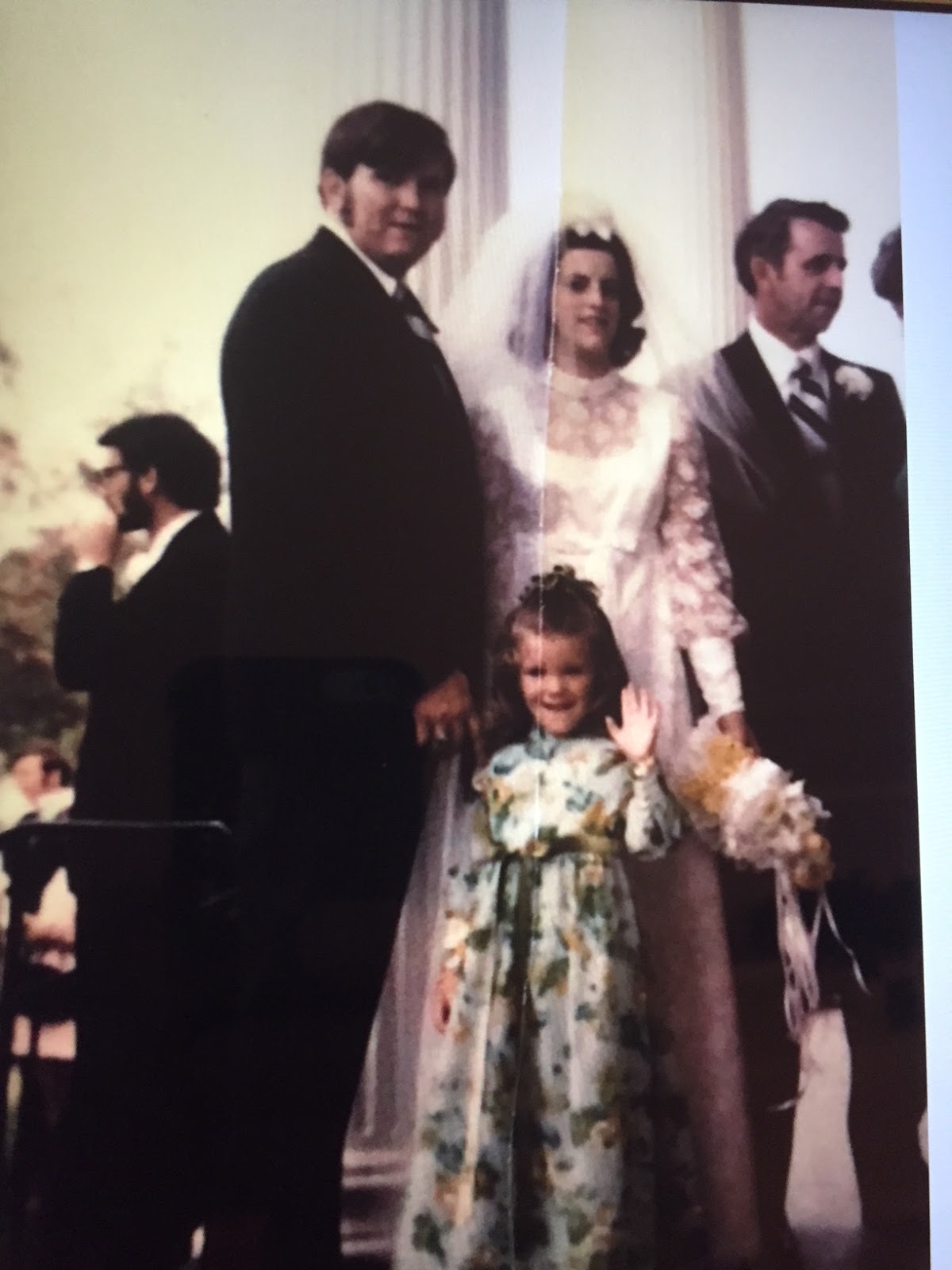
    She went through her 'archives' and forwarded this photo :

                   As Flower Girl at Bob and Shirley's wedding

     Bob is now 'officially' retired, although he still assists a nearby church during their pastoral interim.  And, he works with his son in his tending to his beef herd.  As father of two and grand-father of six, he much of his time is spent with family.

    Maintaining a long tradition, every Thanksgiving the extended family gathers at Bob and Shirley's home for glad reunion, too much good food, thrice told tales repeated annually with occasional slight embroidering, and, of course, maintaining the family tradition of naps.

        His one grand-son and five grand-daughters luxuriate in the abundance of love and nurture that Bob and Shirley give them.  This  recent picture captures his delight in being with them.


   He's my 'baby brother' and I am proud of him and love him.

      Satchel


Saturday, May 5, 2018

The best time of the day . . .


   "Morning has broken, like the first morning . . . " . So sang Cat Stevens in his version of the song written in 1931.  Today at 5:45 a.m., I revisited  a frequent option . . . back to bed for another hour or so or get up, have coffee , meditate and enjoy the quiet.  Gratefully, I opted for the latter despite hearing the long-ago lyrics: "Oh, how I hate to get up in the morning".

   Now, I am a bona fide Myers-Briggs Introvert.  I love my wife, our dog, family, and friends .  Still (was going to change that word, but it seems to fit ): [Being] still, I can feel my soul's  'batteries' being recharged.  And, early morning seems to be the ideal zone.
As an added bonus, sometimes that makes me easier to live with (sorry about the preposition).

   Sacred scriptures extol the need and the benefits of early morning quiet.  And, I remember lines from a pious poem learned when a teen: "I met God in the morning, when the day was at its  best." ( apologies to the late Bishop Cushman if I misquoted).  My late friend, J.R., regularly arose around 4:30 for meditation and reflection.

   'The world' makes a lot of noise of varying decibels.  Early in the morning, even  the whirring of a refrigerator is LOUD.  My corner office faces a busy intersection across from a large hospital .  After several years in that location, I can distinguish the sirens of fire trucks, police, and emergency vehicles without even a glance out the window.  And sometimes, just for added volume, the AirCare helicopter joins the raucous. 

   But, back to mornings. The above photograph of a December sunrise over the Atlantic captures for me the restorative benefit of watching morning 'break' yet again.

   Years ago, there was a   Pogo Possum cartoon where the Owl motions to Pogo to join him in a boat. After a time of  shared silence, Owl commented that nothing compares to early morning silence.  Pogo: "Makes you wonder why more people don't try it."

     Satchel


Friday, April 27, 2018

"IF IT WERE NOT ATTACHED" . . .


         Dad was a kind, truthful man, not given to saying deliberately hurtful things to his sons.  Early in my life, however, he identified a .  . . what? . . . habit, trait, behavior, . . . that has persisted throughout most of my now 80 years.  Consequently, 'age' cannot carry the explanatory freight.  It occurs with annoying regularity, never at a 'convenient' time and often  involves somewhat expensive items.  More often than I would like to acknowledge, his observation raises its troublesome truth: "Son, reach behind you and see if you have your butt.  If it were not attached to you, you would lose it." Dad died in 1992 and I seem still to 'honor' his observation frequently.

    Last week it was a credit card which I finally located on the front seat of my wife's automobile which I had driven to the pharmacy instead of my own.  Several months ago, I could not locate my new  bi-focals.  My wife found them a couple of days later at the bottom of the hall closet where they had fallen when I was fetching the dog's outdoor paraphernalia .  Keys ? Regularly !  Today, it is the hearing aid for my left ear.  The tiny computer in that apparatus costs more than the  laptop with which I am  typing this.

   About 1 p.m. I discovered the 'absence' and called my Audiologist in a nearby town.  Her office telephone answering machine notified me that Friday's closing time is noon, with a Monday morning reopening.  Well, by that time I will be well into my office appointments.  My clients may have to speak loudly.  Thankfully, my hearing is not greatly restricted.  And the hearing aid is insured, so that reduces the stress somewhat.  While there are scheduling and monetary components , those are not  what make the entire matter bothersome.  

   Over the years, some things have been 'found'; others, not so, notably a wallet some 18 +  years ago.  Once after attending a movie, I discovered that I no longer had my check book.  After providing identification, the theater manager returned it.  On our wedding trip, my wife and I spent the second full day retracing our steps of the first day in search of the checkbook.  "What will be next ?" is a troublesome specter.  

   Maybe I should organize a 'search party'; after all I have been away from our house only briefly today.  Or, perhaps offer rewards for those who find my prizes.  So, if you spot it, it looks like this . . .  only for the other ear.


                          Satchel


Saturday, April 14, 2018

PITCHIN' HORSESHOES


    Does a RINGER count five points or three ?
       Do you give three points or one for a LEANER ?
          If my ringer tops (lands over) yours, does that cancel yours or count double for my throw?
            Is a game 11, 21, or 40 points ? And, if we are playing the 21 version and one team scores an 11-0 advantage, is that still called a 'skunk' and a win ?

  These are not esoteric considerations for the serious horseshoe pitcher.  There now is actually a  NHPA ---which i assume means 'National Horseshoe Pitchers Association'.  Their 'rules' vary significantly from those that informed my early playing, one particularly noteworthy variation being the actual 'instruments' of play.  I was an adult before I saw the 'regulation  shoe' that no self-respecting equestrian would consider wearing. These weigh approximately two and a half pounds whereas actual horses' shoes vary in size and weight, like the facsimile above. The game likely was 'invented' by blacksmiths and ferriers who provided and fitted the original footwear.

   The origin of my love of the game probably  goes back to the Christmas gift of a  Ring-toss set when I was  three or four years old.  When I was early teen ager, I was either 
"'fair to middling' " or dad was a very indulgent parent.  He would take me along as his pitching partner for the frequent Sunday afternoon games with the men  gathered at Mr. George Brooks's yard.  He encouraged me to develop my own 'style' of gripping and throwing. I never mastered his technique of holding it on the side and spinning it towards the stake. I preferred the 'hold it by the back and toss end over end' method.  

    My most memorable game occurred in the 1970's at a faculty picnic.  I was paired against my colleague Norbert. He threw a double ringer ... worth 10 points.  To my amazement and his consternation, I also threw a double ringer which by our rules counted 20 points.

   I seldom play now. Not many folks have 'pits' and ,anyway, my shoulder protests the weight and motion.  There was a time when I played reasonably well. A kind of horseshoe tournament once was a staple of our family Thanksgiving gatherings.  (Now the game of choice seems to be BeanBag toss. )

Waiting to follow brother Dennis's pitch.  Family Thanksgiving gathering
when our shoulders and arms were younger.
    
    And I have known some fierce competitors. My cousin Clarice's husband, Roy, was essentially unbeatable, as he often let us know.  My fraternity brother, Jack Sugg, won the intramural horseshoe  competition in the late  1950's. (I learned this a few years ago when I came across a journal that I wrote intermittently in those years.)

    According to an old superstition, horseshoes are a symbol of good luck and were (are) placed in prominent locations in homes.  Well, I've 'lost my horseshoe' for playing but think it would be great fun to pitch one more ringer.

      Satchel


Thursday, April 5, 2018

MOM'S 100TH BIRTHDAY


'CHATHAM COUNTY, NORTH CAROLINA, April 6, 1918...
        Grover and Verdona Phillips Cooper announce the birth of their fifth daughter whom they have named Mildred Leona."

   So might the local newspaper have noted her arrival.  Five other children came later.  Ten of the twelve grew to adulthood ---two having  died in their early youth. Her early years were spent on a hard-scrabble farm where her dad scratched out a living.  In time, he became postmaster in the mill village and his wife  acquired employment in the cotton mill.  

   At a young age (she always said that she was "mature"), mom eloped with an eligible bachelor in the village. She and dad had been married for almost  60 years at the time of his death.


Earliest photo of mom as an adult
probably mid to late 1930's

        Finding employment during the Great Depression of the 1930's was a challenge for dad. Eventually, his dad helped him secure a railroad job in Montgomery, Alabama.  In time his pregnant wife joined him and I was born in that city. Soon thereafter they returned to North Carolina.  Being proud of her first  born, she apparently had regaled her parents with stories about him.  Grand-pa Cooper on first visit apparently was less impressed with his grand-son's beauty and quoted an ancient Talmudic proverb: "Every crow thinks hers is the blackest."


At Kenan Stadium
Chapel Ilill,NC
Late 1930's-early 1940's

    Despite their considerable native intelligence, due to various circumstances, neither of our parents completed high school. That experience caused them to emphasize the importance of formal education (while never becoming 'uppity') .  Mom was proud of her GED  and the LPN degree that she received after her three sons were adults. I often comment that I was a college graduate before realizing that I had an option.  

   Frugality, thrift and the integrity of hard work remained life long values for our parents. But they were never miserly.  Whenever I had 'payday' in my high school jobs, she always insisted that a portion of that was for savings.

    While not especially verbal about her love, mom  expressed her love and affection through her cooking, and she was 'world class'. Chris (pictured below with mom and her oldest grand-daughter) always liked to visit because, as he said, "Grand-ma cooks old-fashioned."   Sunday 'dinner' (eaten after church) usually featured fried chicken or roast, fried okra, potato salad, a made from scratch cake, sweet iced tea, and other items since decreed 'unhealthy'.  And, special occasions such as Easter, Thanksgiving, Christmas  and birthdays . . . well, 'you had to be there'.  In the 1960's, mom took her skills to the local public school where she managed the cafeteria for several years.  I am including a sampling of her recipes at the conclusion of this blog.

    The younger of my two brothers also wrote of her cooking in his weekly column in the local weekly newspaper:

"Mamma could cook. She had to in an effort to feed three bottomless pit sons and a hard-working husband, as well as herself, as well as the crowd of relatives who dropped by often, the neighbors who came over, the friends we boys brought home from high school and college, the families she fed when their luck got down or there was a death in their family."

    For  all her other positive attributes and  achievements, mom particularly excelled in one area:  'Grand-parenting' ! She showered her eight grand-children with affection, advice, candy from her not-so-secret hiding place,  modeling kindness for one's neighbors, droll humor, sage sayings and . . . well, ever so much more.
Family lore tells how their oldest grand-daughter (my daughter) in early attempts to say 'grand-ma' and 'grand-pa' did not master the 'grand' portion; thereafter, they pretty much answered to 'ma' and 'pa'.
With Chris and Kirstin

She believed that it is a grand-parents duty to spoil .
    After dad's death, mom lived alone for several years until a surgery-gone-awry left her unable to walk.  She made the decision to move into a nearby nursing home.  Among the residents were many friends of her age cohort  so she had a 'ready made' social life until her passing in 2003. 

Late 1970's
    So, she would have been 100 years old on April 6 were she living today. 
   100 !! Without being 'soppy  sentimental' (as she might have termed it), I have thought several times this week of the late 'Bear' Bryant's long ago "reach out and touch someone" commercial for AT&T : "Have you called you mama today? I sure wish I could call mine."

    Satchel

Mom's 'Cold oven cake recipe' in her own handwriting:


Tomato Pudding:
  1 quart tomatoes           4 slices of bread
  1 egg                             1/3 cup sugar
   Salt and Pepper to taste
   Mix above ingredients, pour into buttered pan, cook at 350*
for one hour. Sprinkle top with cheese, cook until melted.


Sunday, March 25, 2018

"Amount to something . . ."


       His small midwestern town of the 1950's  offered little encouragement to 'be all you can be'.  Then a family with a less provincial perspective moved into the area.  Recognizing the young man's native intelligence and potential, the older man encouraged him to "amount to something" with his life.  There was nothing in the admonition that belittled, that demeaned the ambient culture.  Rather, it was encouragement and recognition that someone believed in him more than he possibly believed in himself.

    En-courage has been defined as 'putting heart into someone'.
The older man was not trying to 'clone' the teen-ager nor attempting to have him be someone other than who his own potential could achieve.  Consequently, the young man experienced a new  'Hope' for his future.

   Thereafter his life fulfilled the promise inherent in a long ago song "I'm just an old chunk of Coal" by Billy Shaver: "I'm just an old chunk of coal but I'm gonna be a diamond some day. I'm gonna grow and glow till I'm so  blue perfect ".  Because of his professional and personal life, I know that countless lives were changed for the better.  

    I wonder how many others in this life need someone to 'believe in them' . . .
      
       Satchel


Thursday, March 15, 2018

"I NEED TO MOW THAT DOOR . . . "


         "When my teenage daughter threatened suicide, my world turned upside down", the client said.  "For a couple of years we had known that she was 'troubled' but figured that, for the most part, these  behaviors were part of being an adolescent."  That all changed on the Spring afternoon when the daughter specifically threatened self-destruction and fled their house.  Disappeared !   Several hours later,  she called from a friend's house, talking nonchalantly as if the events of a few hours earlier had never occurred. Somehow, they were able to coax her home,  alerted the police who transported the daughter to a local hospital where a child psychiatrist determined that indeed for her safety hospitalization was mandated.

    The days that followed became a blur of tasks, details, 'have to's' with many routine chores falling unattended, such as mowing the grass. Consequently, the front lawn which was already grown up at the time of the tumult, had grown well past the point of needing attention.  Three days after the crisis, entering the  the driveway  the father in his peripheral vision caught a glimpse of the high grass.  Parking the automobile in front of the large sliding  garage door, he remarked, "I need to mow that door". The incongruity of having conflated the two scenes  prompted his immediate laughter.

    When the client told that story, I immediately knew that stress
does funny (not necessarily humorous ) things to our brains.  I thought of that story this week when two other clients who have recently experienced family deaths told me that they were having difficulty remembering and feared that it indicated 
the onset of some form of dementia.  In their cases, such a diagnosis is highly unlikely.  

   Loss is usually experienced on several levels of our very being ---including physical functions.  Among the effects can be short-term memory issues.  It also follows that if grieving is allowed and expressed, at some point memory and other brain functions return to 'normal'.  Along the way, basic A,B, C's of self care need to be observed:  adequate rest, good nutrition, etc. 

   Occasions of 'mowing the door' I hope will not aggravate our grieving.
     
   Satchel

The story is true.  Details have been modified for privacy/confidentiality.


Saturday, March 10, 2018

MY FRIEND DIED . . .


With J.R. in younger days


      Just a few weeks ago in a blog post on male friendships,  
I wrote of my long time friend and soul brother, J.R.  We first met in the Fall of 1960 when at Boston University School of Theology.


Fall 2016 visit to his West Virginia home


   Last October when  we were together with him and his wife,  I read him some of my writings and he offered strong words of encouragement to continue and expand my efforts and to send him pages that I wrote.  Being minimally interested in the world of technology (specifically computers), he asked that I call him when I had published and he would have his wife to print it from her computer.  So, on a Sunday evening I wrote and published the piece. The following morning, I called him to let him know that it was 'out there'.  From the moment he said 'Hello', I knew something was amiss.  He had been diagnosed with metastatic cancer and advised that he probably had a year or year and a half remaining.
 Just a couple of years ago, his oncologist had told him that he was free of the Stage IV lymphoma diagnosis.

   Facing what he called this "next chapter", he told me of two books that he intended to read as he died with intentionality.  Ironically, he had given me a copy of one of them in  1997 ---Stephen Levine's A Year to Live --- with a personal inscription.
The other book had been recommended to him by his long time mentor, Father Thomas Keating.

   We spoke by telephone on two later occasions and agreed that we wanted 'face to face' time.  So, when I called a few days later and his son-in-law, a highly respected physician, indicated that his condition was deteriorating, we made  plans to drive there on Friday, February 23, the day after my 80th birthday.
For years we  kept the tradition of calling each other on birthdays.
When my telephone rang early on the 22nd, I was not prepared for the news.  His daughter told me that he had died during the night.

   This, of course, is not my first experience with grief . . . but it is, what ?, different.  And, my clients often teach me about the many faces of grief, including not to suppress it, not to be impatient with it, and that we never 'get over' it but eventually . . . again, what ? . . . adapt, move on, etc.  I just had a new 'nominee': 'Remember' and remember with gratitude that our lives intersected in the long span of Time.  As Bob Hope said, "Thanks for the memories!"


Beethoven quote that J.R. kept on his bookshelf
    Satchel


Saturday, February 17, 2018

17


           1, 2, 3, 4, 5, 6, 7, 8, 9, 10, 11, 12, 13, 14, 15, 16, 17  !!!

And these Floridians are but the most recent ones.  They all had names and futures (many 'bright' ones) , and they all had families who loved them and they all had the right to live.  And none of them should have their passing sullied by the rancorous, vile, hateful words that are passing for discourse in the aftermath.

It has often been said that "violence is as American as  apple pie", harkening to the 'Wild West' and 'the right to bear arms'.  Do military Drill Instructors still demand of their trainees as was done in 1962 when I was in Basic Training: "What's the spirit of the bayonet?"  To which we were dutifully to chant: "To kill!" Okay, that was military training but I think the same question can be posed for AK-14's.  They are for killing and as is often pointed out, they are not for hunting wildlife.  Rather restricts the potential 'targets'.  

Which brings me back to Florida and the many other tragedies  in recent years.  Every time the same mantras, the same platitudes ('thoughts and prayers') get spouted: 'it's not a gun issue; it's a societal matter'; it's a mental health issue; guns don't kill people ...people kill people.'  On it goes.  I do not disparage 'thoughts and prayers' 
         . . . but something else is lacking.

    In the meantime,  17  !

        Satchel