Saturday, November 1, 2014

SON-IN-LAW


       He is very modest and one least likely to 'toot his own horn'.  In his profession, he has been very 'successful', being at 43 the President and CEO of a major corporation in the US.  But, if you were to meet him outside that context and were otherwise unaware, nothing in his demeanor and conversation would be a clue of the position he holds.

     And, while his professional accomplishments and stature are 'impressive', what I admire most and am most grateful for is his love and care for his wife, my daughter.  During their wedding, I said 'a father can tell when a man is kind to his daughter' which he had already abundantly demonstrated.  However, in the past six months, the depth and expressions of his love and caring have been extraordinary.

    In the Spring, my daughter was diagnosed with breast cancer.  What a courageous, brave and honest woman she has been throughout those months of unexpected complications . . . during one chemotherapy session, there was a 'leakage' into her hand, resulting in a significant burn.
Her weakened immune system brought on C-dif which (the doctors later told her) came within "an inch" of ending her life.  Now, she has had a second onset of shingles to go with the neuropathy in her feet and the 'chemo-confusion' with her memory and thoughts.  Occasionally, she and friends have recorded her journey on a CaringBridge Blog. (CaringBridge.org,  site Kirstinhoff)

   Through all this, my son-in-law without complaint has 'stepped up' and filled many supporting roles.  (And, just saying it in that manner seems tame.)  On occasions when I have been there, I have seen many evidences of his love for her and their children.  Seeing him prepare the children's breakfasts, make their school lunches, check homework, attend to routine tasks around the home, continue to stay abreast of his work responsibilities, all the while being 'rock solid' for her . . .  well, I find it difficult to find the words to express my admiration, gratitude and affection.

    Recently, she completed her radiation treatment and on the last day, her hospital's staff had a party to mark her milestone.  Here is a picture of them leaving the hospital that day:


I am glad that he is "Family"

Satchel

Thursday, October 30, 2014

BOO !!


      What scares (frightens) you?

     Tomorrow is Halloween. Boo! Are you frightened? It is an occasion whose 'meaning' and 'observance' have shifted greatly over the years.  The current 'fears' that mark the  date  derive from  some ominous realities . . . such as persons who put razor blades and other hurtful  substances in the candy given to "Trick or Treat -er's" and real vandalism that masquerades as 'pranks'.  In my youth (which was not, as some allege, the time when dinosaurs roamed the earth), the extent of mischief about which I had knowledge (please, not necessarily the same as participation) included activities such as marking windows with bars of dry soap or overturning outdoor privies.  And there are vague memories of  Halloween 'carnivals' in the school's gymnasium.  Pretty tame stuff.


     Some Halloween historians trace the origins to Samhain, an ancient Celtic celebration that marked the end of the harvest season and onset of Winter and a time when it was    presumed that the distance between the worlds of the living and the dead was thin.  

    Others claim a distinctive Christian origin for the occasion. It was the Eve (evening) before All Saints Day or All Hallowed Eve . . . a time for remembering the Saints, martyrs, and other beloved dead.  Try saying "All Hallowed's Eve" as rapidly as possible several times and what does the sound resemble?

    Perhaps it was but a short step from observances focused on the dead to 'scary stuff'.  Perhaps you have heard the ancient Scottish prayer: 
    "From Ghoulies and Ghosties,
      Long-leggitie Beasties,
      And things that go Bump in the night,
      Good Lord, deliver us."

In our sophisticated era, we don't believe in 'ghoulies and ghosties' and such, do we?  Probably no one reading these words has had an encounter with a real-life 'long-leggitie beastie'.  So, why has this prayer lingered and been recalled for centuries?   Beyond a certain lilt in the prose, I suspect that it has reminded many of their own internal ghosties such as the unknown and things we cannot control, as well as specific fears.

   There is a distinction between  'fears' and 'worries'(aka 'anxieties'). Fears are real or potentially so; anxieties are 'might be's' or 'what if's'.  "Do not walk down the middle of the interstate, there are speeding automobiles there" . . . the probability of being hit is high.   "What if you leave your house?  There are cars outside and one might hit you" is a stretch. Whether spoken or not, 'what if?' is a strong indicator of anxiety. 

   Perhaps only an incorrigible Pollyanna would deny that there are real dangers in the world . Among some obvious candidates : Ebola, ISIS, influenza, bankruptcy, war zones, cancer, unemployment,bullies, deranged persons with weapons, automobile accidents . . .  'Bad things' do happen. . . to 'good' and 'bad' people alike.  A certain prudence or caution is necessary and appropriate.  It is an entirely different matter when those  get ramped up far  out of proportion, whether by someone's   deliberately manipulating our  frailties for whatever motivation or by our own 'hot buttons'.

    So, whether we are opening our door to 'Trick or Treat' or opening our awareness of our 'ghoulies and ghosties', 
maybe this ancient prayer will have  contemporary relevance for us.
  
    Satchel


Thursday, October 9, 2014

ON NOT LEARNING BY DEGREES . . .


        Several years ago,  a minister showed me the small library he had  acquired when a student at Duke University Divinity School.
He then boasted that he had not reread nor considered any of them useful since.  He implied that he had his degree and his education and did not want to be bothered with further learning.

      In the past two posts, I have made references to Joan Chittister's The Gift of Years: Growing Older Gracefully.  This book of  reflections on various issues associated with aging has stimulated several personal 'inventories' recently.  Reading her comments on "Learning" reminded me of the above mentioned minister who apparently felt that he had learned all he needed to know.  By contrast, she noted as a "danger" the assumption that with the completion of high school or college "we have completed our preparation for life.  The problem with degrees", she added, "is that they wear out quickly or prepare us for only one small area of life, at best." [p. 95]

    Illustrative, perhaps, was the good-natured lampooning of an instructor at a geriatric conference that I attended over  a dozen years ago.  Gil (not his name) was a physician who lectured on physiological changes brought on by aging.  In our 'Fun Night' skit at the end of the two-week course, one of the students playing our teacher groused that "half of today's knowledge was unknown at the time I received my degree; a quarter of what I learned I have forgotten, and another quarter has been superseded by new discoveries.  Consequently, I know nothing !"

    There is an outworn adage to the effect that "you can't teach an old dog new tricks".  The obvious conclusion in human terms is that mental acuity diminishes with accumulated birthdays.  The antidote to the error in the adage is that "an old dog can learn new tricks, provided two conditions: The old dog has 'half a brain' and the old dog wants to learn new tricks.  Ms Chittister again: "Neurological research now confirms that old brains are indeed physically smaller, but no less intellectually  competent than younger ones.  And in some ways, in terms of reflection and creativity, they are even better, if for no other reason than that they have a lot of experience to add to intellectual acuity."  [p. 96]

     Not to be flippant about the tragedies of various forms of dementia,  most 'old dogs' have the capacity to learn those 'new tricks'.  It seems that the keeping the 'want to' alive and fed that is crucial, for as Ms Chittister observed "ongoing learning saves the aging from becoming more  fossilized than transformed.  The problem with aging is not age, it is petrification, rigidity of soul, inflexibility.  Only ideas keep ideas flowing.  When we close our minds to what is new, simply because we decide not to bother with it, we close our minds to our responsibility to ourselves --and to others-- to keep on growing." [p. 98]

     Since my mid-20's, I have remained grateful for the influence of the Reverend William Jenkins, a then 89 year old retiree, who would  borrow my texts or supplementary readings and upon returning them would inquire , "What do you think Paul Tillich meant  by such and such ?"

   While the topic probably will not be some point in Tillich's  theology, like Mr. Jenkins, there is still a lot that I want to know.

    What kind of 'new tricks' do you want to learn?

        Satchel

Thursday, October 2, 2014

FUNERALS


      Recently my wife and I attended two funerals. One was for the husband of one of her former colleagues; the other, a friend from a church where I had been minister for nine years and whom my wife had known all her life. Their services reflected that each of the deceased was a "good man", a kind person, a person of strong religious faith and practice. Other similarities -- both were older men with strong family ties, both had a love of Bluegrass music that  was  expressed in their respective funerals.  The ministers conveyed both the dignity and the humanity of the departed.

     In the years that I was a parish minister, I conducted many funerals.  Occasionally I was asked  whether it were more difficult doing that for someone with whom I felt close or for someone whom I knew only marginally, if at all.  Having done all of those, I replied that there is no 'easy answer' . . . each presenting its own challenges and opportunities.

     In 1963, Jessica Mitford wrote The American Way of Death, a critique of many of the practices of the 'funeral industry', as well as   some of the customs surrounding death and funerals.  Over the course of my life, I have noticed several changes in customs, as well as several constants. . . at least among my own cultural cohort. Among the 'constants' has been the custom of friends and neighbors bringing in lots of food for the family and their guests.  Floral tributes have likewise continued as a mainstay though now many families request that instead of flowers,  memorials be directed to specified charities or causes.  Cremation followed by a Memorial Service also seems to be becoming a more common practice.

   Gratefully, the custom of bringing the body back to the residence and there being persons to 'sit up with the dead' through the night has being largely replaced by the 'Wake' or 'Visitation', usually at the Funeral Home on the evening prior to the service.  Even that can sometimes feel oppressive.  Sometimes a family will 'receive friends' for a specified time just before the actual funeral. At the wake we attended, a full fifty minutes passed between our arrival in line and actually reaching the family, such was the outpouring. 

     Also, largely gone is the practice of having an open casket during the service, frequently accompanied by loud wailings.  A friend told me of his uncle's funeral in another state :  the first of three ministers recognized that he had a captive audience and launched into a 'come to Jesus tirade' that lasted 20-30 minutes.  The second speaker, not to be outdone, duplicated that performance.  When the third man began his comments, the daughter of the deceased stood and directed him to 'shut up and sit down', whereupon, my friend related, the funeral "came to a screeching halt".

   It is difficult, of course, to speak of 'funerals' without also speaking of 'death', few persons' favorite conversation topic.
The French writer, La Bruyere, wrote that "we hope to grow old, yet we fear old age.  We are willing to live and afraid to die."  Somewhere on my office shelf is the book, The Denial of Death.
I haven't yet read it.  Woody Allen perhaps caught the sentiment of many when he quipped something to the effect, 'I don't fear death; I just don't want to be there when it happens.'

    Joan Chittister whose writings on aging I have found helpful, sagely observed that "I have no idea what the moment will be like. I only know that I will be alone. . . . It is the moment of absolute surrender. . . . But not until I have sucked every minute out of life I can."  For persons of religious faith, she further noted, "whatever our questions about God, about Life, about the End, we have a certain confidence in our lack of confidence in the unknown.  We are not sure who God is, of course, but we are confidently sure of who or what God is not." ("Faith", in The Gift of Years, p. 212)
I just realized that I am writing this on the 22nd Anniversary of my dad's death.  Beginning in his mid-40's, Dad had been a representative of Metropolitan Life Insurance Company.  A man of quiet faith, he told me in his later years, "I have delivered too many death benefit checks to families to deny the certainty of death.  I do not fear it but I am not walking out to greet it."

     These reflections then have arisen primarily from having attended Lynn and Odell's funerals.  The music gave strong affirmation of their faith.  In Lynn's service,  Come, Angel Band, sung by the minister and two other men bespoke his bedrock belief.

    As a musician, Odell  had for many years  "made music" with several groups and individuals.  I had primarily known him as the Bassist in the Maple Springs Strings, our church's home-grown talented musicians.  His son, Stan, is a world-class banjoist, having once played with Bluegrass legend, Bill Monroe.  Stan's wife, Julie, is a classically trained artist as well. (Appropriately, it was Odell who had first introduced them several years ago.) They and their friends sang what I had known as Odell's 'signature song',  Not Afraid to Close My Eyes and Die.  At the conclusion of the service, the minister invited any musician in the congregation who had ever played or sung with Odell to come to the podium, whereupon they offered the classic, Will the Circle Be Unbroken.  Never have I heard Stan play with such energy, force, conviction.  While at no point was the grief of loss denied,  my dear friend, Billy, summarized the proceedings as we were exiting the church: "That's the way it should be . . . a celebration."

   RIP,  Lynn and Odell.

       Satchel


Thursday, September 25, 2014

WHAT ARE YOU GOING TO BE WHEN YOU GROW UP?


   Within the past week, I have had three clients . . . one man in his mid-50's, another in his late 40's and a woman in her early 30's . . . ask variations of the same question : "Why don't I know what I am supposed to be doing with my life?".  Their question is a rephrasing of sorts of the title of this post and the impetus for my own reflecting on the  matter.  

    A caveat at the outset . . . many millions do not have the , what, luxury, even to ask the question.  Every day is a repetition of the preceding day ... off to the 'salt mines', trying to scratch out a living, keeping basic human needs met.  In the words of Ernie Ford's Sixteen Tons:  "Saint Peter don't  you call me , 'cause I can't go.  I owe my soul to the company store."  And there are also the unemployed.

    Yet, for many others (and not just the elite), there seems to be an assumption that the career path that I chose when in my twenties will continue to be the road to success (however defined, often monetarily) and fulfillment.  However, for starters, the era of 'work 40 years in the same job, retire and get a Gold watch' is over.  In a time of 'downsizings', terminations and economically-driven readjustments, many folks have to contend with externally imposed unemployment or under employment.

    Moreover, a kind of conventional cultural claim (at least in the United States) has been, 'go to college, get an education, and you are set for life'.  Let's just say the obvious and perhaps it  is somewhat akin to a book title that I remember: In this country, there is a kind of Sheepskin Psychosis which in the minds of many runs rather like, 'if you don't have a degree, you are automatically second-class.'   My own blue collar origins and later many years teaching in academe tell me that such a view is just plain wrong and even mean-spirited.  Moreover, a 'google' search produced the statistic that only 27% of college graduates work in areas that are related to their majors.  My strong belief is that while college  obviously can prepare and equip us for specific 'jobs' or 'professions', if it is only Hire Education, something vital is being missed.

     Along with externally imposed transitions, there are also those brought on by internal shifts.  Our counseling center helps train Interns and Residents who are, for a variety of reasons,  'second career'.  Sometimes the reasons reflect new interests, developing proficiencies, 'empty nest', an emerging sense of purpose or call, or other equally valid reasons. Some of these may represent so-called 'mid-life transitions'.  In 1963, as part of my seminary experience , I studied for a year at Duke Divinity School.  Like most of the other students, I was mid-20's.  Bob Bryan, as a 35 year old, was an anomaly.  Today, I suspect that many seminarians are 40 and older.  In the late '90's, I supervised two second career Duke Divinity Students in their 'field work' programs. An acquaintance has recently left a large parish to enroll in a hospital chaplaincy program.  Another 'successful' pastor, highly respected within his denomination is seriously considering whether he might be 'more at home' within a smaller parish with two 'tiny' churches.

    Among the possible 'meanings' or 'interpretations' of these developments, I would offer shifting definitions of the aforementioned Success and fulfillment.  While compensation remains important, other factors matter.  A book by Parker Palmer, Let Your Life Speak has been influential in shaping my understanding of 'vocation' which is not synonymous with 'job' or 'profession'.  Quoting from the jacket cover: "Vocation does not come from willfulness, no matter how noble one's intentions.  It comes from listening to and accepting 'true self' with its limits as well as its potentials."  Resisting the urge to write a review of the book, I just note that I re-read this 'jewel' every Christmas holiday and each time there is a new 'takeaway'.  And I like Frederick Buechner's aphorism to the effect that our vocation or calling lies at the point where our deepest gladness and the world's deepest needs intersect. 

   In her book, The Gift of Years, Joan Chittister wrote that when we teach children to be 'successful', we are actually teaching them to be  competitive, and "it is not so much the striving that is the problem as it is the sacrifice of all the other dimensions of life." (p.114)   She further asserted that success "has to do with having the basics, with learning to be happy, with getting in touch with our spiritual selves, with living a balanced life, doing no harm,          doing nothing but good." (p.116)

    Discerning how to live that out usually requires patience, some 'failures', 'false starts' and a willingness to take a risk, or, if you prefer, a leap of faith.  At least, I have found it to be so.  Over the years, I have been: Executive Secretary of a college Alumni Association, Army Private, Secondary School Teacher, College Professor, Entrepreneur, Parish Minister, and later, Psychotherapist and Clinical Supervisor.  During the 1990's, I worked both as parish minister and therapist.  Then, in 2001, at the age of 63, as I became full-time therapist, I decided what I was to be "when I grew up".  Some of those shifts were externally caused while others were responses to internal awarenesses.  Upon reflection, perhaps with the exceptions of my brief military stint and entrepreneur role, while the 'manifestations' of my vocation have shifted, a recurring theme has been 'teacher', not seeking to 'indoctrinate the students, but to encourage them to think, to find their own 'truth'.  Would I have liked more financial compensation?  Of course. But what might I have had to sacrifice ?  At an age when many have retired, I suppose that I am still honing my definitions and implications of 
"Success".  

    What do you want to be when you grow up?

        Satchel


Thursday, September 11, 2014

'FACIAL FOLIAGE'


    All week I had been mentally composing a post about 'facial hair'.  Then yesterday, a bearded client wearing these socks came to my office for his psychotherapy session: (for HIPPA sensitive folks, he gave me permission to photograph these but not to tell you that his name is Sigmund Fraud.)


I took that as , well, not a 'sign', but at least a confirmation for proceeding with the 'musing' . . .  in general and of memories of some of my own 'crops of  foliage'.

    Wondering what had brought the topic to mind, I remembered an ministerial installation service last Sunday when there was quite an array of clerical  beards in attendance.  No big deal for the most part in 2014 but it has not always been so ... for ministers or other 'reputable gentlemen'.  When I searched various websites for 'facial hair', the array of 'meanings' surprised me.  (for additional  hair-raising aspects, simply enter 'facial hair' in your search engine.)

    Among 'signals' facial hair might send... mature, sexy, scruffy, 'red neck', aggressive, 'hippie', 'Radical'  . . . are suggestions.  Sounds rather subjective and, like other 'meanings', might be in the 'eye' of the beholder.  Then there was a reported study indicating that men with beards are perceived as 38% less generous, 36% less caring and 51% less cheerful than clean shaven men.  Another site claimed that wearing facial hair can also change one's own behavior and  'self image'.  

    There  was also speculation as to why so few contemporary politicians have either beards or mustaches. The first President to wear 'foliage' was  Lincoln . . . unless John Quincy Adams's luxuriant mutton-chops are included.  After Lincoln in 1861 through William Howard Taft who left office in  1912,  there was a succession of  'Smith Brothers' Presidents. (You know, 'Trade' and 'Mark' on Smith Brothers Cough Drops.)  Only Andrew Johnson who was impeached and William McKinley who was assassinated were clean-shaven. The last bearded Presidential  candidate was Charles Evans Hughes in 1916 . . . he lost.  So, why will no current politician take the 'risk' ?  Ah, perhaps there's a clue.  What would be  'at risk'?  Your answer counts.  Somewhere I also noted an opinion that negative reactions to beards can affect employability.  Perhaps there's the answer to the politicians' clean-cut appearances.

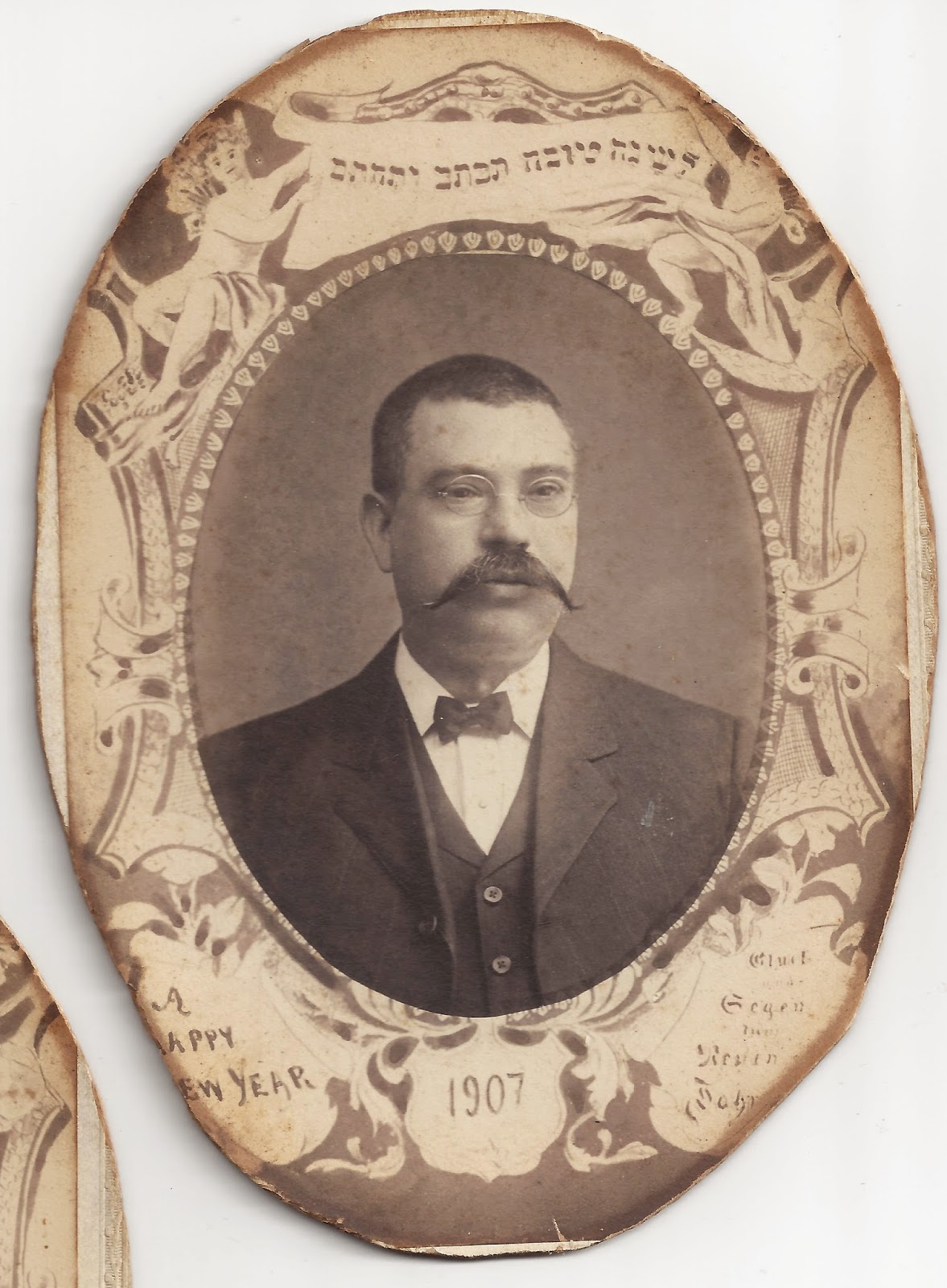
      Somewhere in all that musing, I thought of some of my own 'outcroppings', as well as those of various men in my family.    Both of my great-grand-fathers wore facial hair.  Mom said that her grand-father began letting his grow with the onset of cold weather and shaved in the Spring.   Here is a photograph of dad's grand-father (whom he never knew) with a cultivated  mustache:  (By the way, if you can translate the Hebrew on the frame, we would like to have that):


Both of my grand-fathers as well as dad were always clean-shaven.  Well, dad did grow a mustache for his church's anniversary 'old time' celebration.  I do not recall any uncles or uncles-in-law with beards or mustaches.  Both my brothers, one nephew, as well as the two boys/men whom I raised have or had beards.

    My own first remembered beard was 1964 when I was 26.  At the time, a fraternity brother was Director of a near-by Historical museum.  One day when we were clowning around, Bill photographed this would-be Lincoln look-alike:


For long-forgotten reasons, I shaved this one and did not have another until 1968 when I became a college professor.  Wearing a beard in that tumultuous year could feel hazardous.  I remember but perhaps three or four hirsute colleagues . . . Larry Whitlock in the Psych Department and a couple of the Art Professors.  Once when walking downtown, as two young guys passed me, one muttered, 'Hello, Castro !'.  Then, a student quizzed me: "Prof, what does your beard mean to you?"  I told him that it meant that I did not have to see my face in the bathroom mirror the first thing each morning.  Sometime during the Spring semester, I shaved, clean as the proverbial whistle.  I removed my glasses and jacket, took a seat in the classroom before students began arriving for the 8 a.m. Western Civ class.  No one noticed me  until about 5 after the hour, when I stood and said , "Well, guess we should have class."  There were several groans of relief signifying, I thought, 'glad I didn't say where is the old so and so ?

                               (The Professor and Daughter, around 1971)


     Since that time, I have occasionally grown beards then removed them as I became tired of them.   Once when visiting my then 2 year old grand-daughter and her family, I had decided that the time had come to remove the beard.  Not wanting her to see Papa go into the bathroom and someone else exit, I had her watch the process.  She thought it a hoot.  As the years passed, I  began noting more grey whiskers.  The jet black from earlier 'outcroppings' was becoming 'salt and pepper.'  One day as my daughter and I were running, she looked over and said, "Dad, if you would shave you would look ten years younger."  Ouch.  That, however, was one of the kinder comments that my whiskers sometime evoked, not only from strangers but friends and family alike.  (Sometime later when I did shave, a couple of days passed before she asked, "Dad, have you had a haircut?") The last time I had foliage was in the 1990's when again a parish minister.  Now, when there is the occasional multi-day stubble, I see that the salt has overtaken the pepper.  Surely some kind of vanity about age does not preclude another 'crop'.


                                (Same two people, 17 years later.  Already the salt is overtaking
                                 the face;  top hair came later.  No longer a professor but one of the 'bearded
                                  clergy'

             So, if I ever grow another beard, my preferred 'Meanings' can now be 'Mature' and 'Cheerful'.

     Satchel


Sunday, August 31, 2014

"Hot, ain't it ? ! " . . .


. . . or so goes a phrase often heard around here at this season.  Occasionally, the weather forecast includes a reference to these being "Dog days", followed by pictures of cute puppies being lazy. And, such may be the general understanding of the expression. It's a time when pet dogs and people lounge around, not wanting to over-exert and get 'dog tired'.  The phrase generally refers to the hot, sultry time in the Summer from early July til early September when rainfall is lowest.  The history of the expression lies with the Romans who realized that the stifling weather coincided with the time when the Dog Star, Sirius, rose and set with the Sun.  

    Wikipedia notes that the ancients considered dog days to be an evil time when "the seas boiled, wine turned sour, dogs grew mad, and all creatures became languid."  Indeed, the weather of the season
can produce a stagnation of body, mind and spirit. . . tempers can be short, irritants more numerous (think, mosquitoes, ticks,gnats and  flies), energy is minimal (a former neighbor from England said that the season was 'Damned Debil-i-ta-ting'), and little seems to interest us.  Sometimes we 'drag around' , seeking relief. 

    For many the advent of air conditioning has brought options other than opening windows and doors, or sitting on the porch or under a shade tree. Someone once wrote that the American South at this time of the year is a place where it is 'always 90* in the shade'.  A brother who lives in New Hampshire where the Seasons are but Winter and July 4, has vowed that only a family emergency can bring him to N.C. in August.

    Last Winter I made a solemn promise to myself: "I will not complain about the Summer's heat after all this snow and cold."  So far, I have kept the promise (if this post be excepted). Although there have been ample 90* days this year (yesterday was one and today 'has promise') . . . and more are forecast. . .I am grateful that the challenge of 'dog days' this year has not been as  formidable as in the recent past. 

    Dad often advised 'don't let the monkey get you', meaning don't get overheated. I began musing about various ways we attempted to 'stay cool' when I was a youth.  Before Dr. Salk's vaccine eliminated polio epidemics, my brothers and I spent languid afternoons on a pallet on our back porch, reading comic books and listening to a nearby radio station whose afternoon programming was for kids.  I won a $1 savings bond starter from  WNAO , a Raleigh station, when they telephoned, asking me to name that tune they were featuring.  I missed it, but got the consolation prize rather than the bountiful $2 cash that the correct answer would have fetched.

    'Water' often provided relief.  We called it 'getting under the hose' . . . spraying each other with refreshing coolness.  Dad or other fathers of our group often drove us on Sunday afternoons to Pullen Park in Raleigh, there being no community pool in our town. Returning home, there was always the stop at Dairy Queen.  Mr. Schaub, the father of a school mate, built a pool at their house and often invited my brother and me to swim on Sunday afternoons.  In time, he filled it in with dirt because they had so many uninvited guests. 

    And, there was 'home-made' ice cream, oscillating fans, and ceiling fans and awnings, especially in stores.  'Hand-held funeral home air conditioners' provided some relief.  These were fans that were imprinted with advertisements for local merchants, often the morticians.

      Perhaps the late Nat Cole overly romanticized the 'lazy, hazy, crazy days of Summer'.  Still, I prefer this Season to the 'stuff' we had several months ago.  
   
     Stay cool ! (not cold)
        
         Satchel

Sunday, August 10, 2014

CLISBY


         Last night I learned that Clisby had died; that he had been gone for almost five years.  I was shocked, saddened and embarrassed.  I called to wish him a 'Happy Birthday', Number 77, something that I formerly did with some regularity.  Last year, the date had slipped my mind . . . but what of the other 3 omissions ?!  I would have bet that I had called the previous year.The shock was in the realization of the rapid passing of years; saddened and embarrassed that I had failed to stay in contact with someone who had once thrown me a 'lifeline'.

     In 1982, having lost my teaching job, I became an entrepreneur . . . as a broker of college textbooks.  Through an intermediary, Clisby took note of my business volume and offered me employment as a representative of his company.  The arrangement that eventually evolved was that I would work with the company but not for them.  There were subtle nuances in the arrangement, for certain.  One such was the irregularity of cash flow. . . not exactly 'feast or famine' but somewhere close.  Going far beyond what our agreement  obligated him to do, Clisby found 'creative' ways to assist me through several financial hard spots.  Simply said, he trusted me . . . in many ways, including with large sums of money on occasion. And it was more than a business association. At least once during the brief time we worked together, I was a dinner guest in their home.

     I well remember an occasion when a house payment was due and I had to ask his assistance.  Receiving (or so it seemed to me) some words of displeasure from his boss, Clisby found a way to provide me an 'advance' of compensation.  Working with him and his organization made possible a relocation to another part of the state, a development with unforeseen future implications, notably a entirely new professional career.

    After his retirement, he and his wife moved to the South Carolina coast.  On several occasions when we vacationed in the area, I would arrange to meet Clisby for breakfast and each time again to say 'thanks'.  Last night when his wife answered my call and told me of his passing, I offered my much belated condolences and apologies.  She was very gracious.  I told her again of my gratitude for his friendship and 'saving me ' at that crucial juncture.  She called him 'a white knight'.  He certainly rescued me at a time I was in 'great distress'.  

    Now, each August 9th, I want to remember to say a prayer of appreciation for one who extended a 'helping hand' when I was struggling.

    "Thanks, Clis."
         Satchel

Friday, July 25, 2014

THE JOLLY ROGER


Jack's 75th birthday was last week.  We were undergraduate fraternity brothers back in the 1950's. Then for nine years in the 1990's, I was minister at his home church.  I had not seen him in several years.  For some unknown reason, he was strongly on my mind that day.  So, following an impulse or an intuition, I drove over to his house to say 'hello'.  There was no one at home when I arrived but as I was writing a 'sorry that I missed you' note, he and his wife drove up.  We visited for a half hour or so and it was then that I learned that was his birthday.   It was good seeing him and  catching up on personal and family matters.  Little of our conversation was around 'the good old days'.


College fraternities receive a lot of 'bad press', much of it deservedly, for transgressions ranging from alcohol abuse to adolescent  'pranks and hijinks'.  A nearby university has frequently been in the news for fraternity members allegedly being implicated in a pledge's death.  Another endemic criticism has been snobbery and exclusive-ism.  Selecting members by the secret ballot method known as 'Blackballing' has inflicted great hurt upon countless youth seeking inclusion.

Periodically, I receive mailings from the national office of my undergrad fraternity.  Usually, I do a  'quick read' for any mention of someone whom I might know.  Otherwise, it finds a  quick home in the recycle bin.  Somehow, stories about current members or how old alums are serving as mentors, etc hold no interest. I once knew a man who in his 60's was "Grand President" of the fraternity of his youth.  His vanity license plate bore the 'password' of that group.   My 'fraternity' were the guys in our local chapter at a specific time and place.  In my personal 'archives', I still have the fraternity pin that I wore then.  I guess the 'skull and crossbones' had (have) some kind of symbolic meaning.  If so, that is long lost in the recesses of my remembering.  An undergraduate acquaintance referred to the pin as a 'Jolly Roger', the symbol on pirates' flags with skull and crossbones.

Ours was a small student body where practically all the residential students knew each other.  While there were six national fraternities and four national sororities with chapters represented, it was not unusual to have close friends among other 'Greek' organizations besides one's own.  We doubtless had our share of the 'silliness' and yet, there were shared times and events that made us glad that we  were  part of something 'larger' than our own self interest.  Toward the end of my Senior year, several guys were seriously injured in an automobile accident while en route back to campus.  Four of the Sig Eps were unable to return to classes that semester. I was deeply moved by what had happened and am forever grateful to my 'brother' Charlie (as he was then known) who held me while I sobbed.  Fred recently died 50 + years later, supposedly from complications from that ill-fated afternoon. 

'Naming Names' can be risky, especially when I rely upon my 76 year old 'remember-er'.  But immediately there come to mind:
Reid ('Sunshine'), John, Charlie, Bill, Nesbitt, Fred, Bobby, Ken, Danny, Mickey, Vance, Chetchie ('Big' and 'Little' . . . biological brothers), Jack, Bill Tyson, Shepherd,  'Sweat', Pete, Benny, . . . (No slight intended for omissions.)  Three of them are deceased.  Of the others, we see each other rarely, if ever, and communicate by email, occasional telephone call, or text.  There is a respect and appreciation for our shared past but more importantly, I believe, is the ability to 'meet' in the 'right now'.  There have been mumblings about a get-together, or as Ken wrote me last week: "We ought to try and gather for a shindig one of these days before it's too late.  You do know what I mean."


Yeah, Sully, I think I do know what you mean.

     Satchel

Thursday, July 10, 2014

Tom(my) saw yer fence . . .

. . .and painted it.   OK; it's a weak pun, at best.  If the allusion does not resonate, check Mark Twain's narrative about Tom Sawyer and whitewashing the fence.

     A few weeks ago, we attended a lawn and  garden tour and saw a small tool shed that had a mural painted on the side. Thus was born the idea of adding a mural onto our privacy fence.  Our son, Tommy, (my wife's biological; my relational) who lives in Los Angeles is a talented artist with an MFA.  While here last week, he painted a mural on a  section of the fence . . . with the possibility of adding "touch-up's" and more panels on future visits.

    Watching the progression of steps involved was something of an education.  His work reflects vivid colors and shapes (see his website, www.tommybeane.com, and the various tabs thereon).  After the initial whitening and the addition of the first colors, as a 'non-artist' , I had difficulty envisioning 'where this might be going.'  Fortunately, he did not.

   Over the years, my wife and our friend, Jim, who is a professional landscaper have created a beautiful backyard for us.  Now, with the mural. . . well, as they say, 'a picture is worth a thousand words'. We think that it is 'the perfect addition.'

First, the primer


Q, our Shitzu, 'stands guard'


For perspective, this is from about 40 yards away


I had thought it basically completed with an ice field in the foreground.
Little did I know . . .


Tom Sawyer's fence never looked so good !


Satchel                                                  

Saturday, June 28, 2014

IT CAN'T BE DONE . . .


       I had intended to keep count . . . of the number of times last week clients said that they wanted "to make sure that . . ."  I wanted to tell them that as noble as the aspiration might be, its deliverance is an impossibility.

      As it is often used, "making sure" is a throwaway phrase implying that a full exertion of effort will guarantee an intended and expected outcome.  A 'Guarantee' in the purchase of an appliance, automobile, etc. usually is desirable.  At least, a replacement can be offered.  In human terms, however, there are just too many variables.  Consider, " I want to make sure ['certain' if you prefer]  that our team wins tomorrow's game."  For starters, the other team may get a 'vote'.  In 1949, the New York Yankees and the Boston Red Sox seasons came down to the last game. . . the winner would go to the World Series. The brothers DiMaggio played for opposing teams ...Joe for New York and Dom for Boston.  They were driving together for dinner on the eve of the game and Joe apparently said something to the effect that he would have to win the game for his team the next day.  Whereupon, his brother reportedly said,  "I'll be playing in that  game also."  Well, it happened that the Yankees won and Joe certainly contributed.  What might have caused a different outcome?  As talented as 'Jolting Joe' was, he could not have had perfect control over all the variables of the game.  What if an errant pitch had 'beaned' him in the first inning?  After all, pitchers do occasionally throw wild pitches and there were no batting helmets at the time.

      An athletic contest could be construed as an overly simplistic illustration.  What would you like to "make sure" occurs.?  In the first session with a new client, I specifically say, "I do not guarantee outcomes.  Someone else has a say-so in how this goes and that person is sitting in your chair."  I do, however, promise my best effort, training and experience.

     The late Rabbi Edwin Friedman, a preeminent Family Systems therapist, maintained that the pursuit of total "control" is a modern form of idolatry.  It is beyond the achievement of mortals.

     Where does that leave those of us who want to "make sure . . ." ?  At the risk of being 'trite', I would suggest accepting responsibility to utilize  our  Best efforts in terms of thought, action, talent, consultation, exertion, timing, and the recognition that there are factors at work beyond our own doing.

      That reminds me . . . I need to go remove the bird feeder from the deck to make sure that the raccoons do not eat the seeds during the night.

     Satchel


Saturday, June 14, 2014

As the years rock on , , ,


           Fifty-Eight !!  58 !!  Most of the time I do not even feel 58 years old.  Then the math unremittingly insists that it has been that many years since high school graduation.  I missed last year's gathering.  Had not been to one since #50 and it , like the one today, was but a couple of miles from where we live.   (While I did not attend last year's reunion, a picture from the event prompted my writing of the earlier post "Once Upon a Time".)

      Our numbers have declined . . . of the original 44, eleven have died ... eight of the men and three women. Two men died within the past year.  One of those had been a close high school friend. ("Marlin . . . In Memoriam")  The other had been the class prankster.  Today, there were 17 of us who gathered, along with guests.  

      Evidences of accumulating years and health challenges were unmistakeable.  At times, the mood turned 'heavy' as 
we remembered losses and spoke of rough spots along the way.  Despite that, there was an authentic delight in seeing  each other and in re-hearing some old stories and a few new ones:  Carl's telling of cheerleading for NC State:"Give me an 'S', Give me a 'T', Give me an 'A', Give me an 'E'."  Whoops, left out a letter. ; Ray's comment, "Well, none of us has been in jail", being met by a lone voice that said, "I have".
And there are yet a few of us still working  full-time.

      The strong spirit of endurance and survival there today bespoke again the adage, "Old age is not for sissies."

    Satchel


"Not off our rockers !"

Friday, June 6, 2014

PARACHUTES AND PARATROOPERS


     I have never jumped from an airplane; nor at this stage of my life do I anticipate doing so.  We have a friend who was a member of the famed 82nd Airborne some years ago and he still has fond memories of the time.  During my Army basic training at Fort Jackson, S.C., in 1962,  there was an airborne company just across the street from our company area and we thought them a bit macho, always chanting 'Airborne, airborne' during their morning run.

    My sole close encounter with a parachute occurred that Fall.  After basic, I was assigned to the Third Army Flight Detachment at Fort McPherson in Atlanta.  My grand-parents lived close by in Alabama.  One Friday, two Captains flew in from Fort Rucker, Alabama, for a brief errand on post.  I asked if they would be returning via Montgomery and if so, could I catch a hop.  Well, they could go that way and since they were in a single engine L-19, I would need a parachute.  My section sergeant gave me a week-end pass and orders not to let the pompous First Sergeant know.  I checked out a parachute from the Supply Room, stashed it in their aircraft along with a few personal items for the week-end.  Though given a quick tutorial in how to use the parachute, I had already concluded that if matters reached that level of severity, I was likely already dead from a coronary.

   It was an uneventful flight and I had a good visit with kinspeople, even though my Uncle Sam (really his name) who did not know of my arrival was a bit surprised to see a parachute on his living room floor when he came home from work.  Getting back to my post became another matter altogether.  Not daring to check the parachute with luggage lest a clerk pull the wrong lever and have open parachute all over the place, I kept it with me on the bus ride back to Atlanta.  I was billeted off post in a private residence some dozen miles or so from downtown.  My plan had been to call the hanger and have someone provide transportation to my quarters.  No one was there except the CQ (Charge of Quarters) who was prohibited from leaving.  By now it was late on Sunday night and being AWOL at roll call the next morning was not an attractive outcome.  Finally I hit upon a  'life saver'.  I telephoned the fraternity house at Georgia Tech of the same national fraternity of which I had been a member some years earlier at another college.  I explained my situation, adding that I would be recognizable outside the bus terminal because I was in uniform and carrying a parachute.  There was a long silence and I realized how 'odd' that must have sounded.  At any rate, in a few minutes a couple of guys appeared and drove me home.

    All of that is frivolous compared to the 'real stuff' that occurred seventy years ago today (June 6, 1944) as paratroopers jumped into German Army-held regions of France.  As a small way of remembering and honoring, I have again watched portions of Band of Brothers.  "Hero" is a term that gets tossed around much too easily but those men, who frightened though they were, were heroes all.  I have especially thought of 'Mr. Len' (see earlier post with that title) who was part of the D-Day force, as well as two other men whom I knew when a boy and later learned that they had survived that 'Longest Day'.

    And, now on today's news, there is a story of Jim 'Pee Wee' Martin who was among those jumping into Normandy that morning and now at the age of 93 just jumped again.  Of this last jump, he said, "It was wonderful, absolutely wonderful. . . . I did not compare [with 1944] because there was not anybody shooting at me today."   (Mr. Martin maintains a Facebook page that can be accessed by doing a web search with his name.)

    Often in these posts, I note what I deem the necessity of contradicting the stereotypes of aging.  Horrible things do occur to folks in the post-65 cohort (as noted in my last post).  However, there are things we can do to 'hedge our bets', such as good nutrition and exercises like walking.  While I include Mr. Martin among the WWII heroes, he also deserves that accolade for his recent actions and attitudes.   He acknowledged that he was motivated in part by 'ego' in making this last jump to demonstrate that "I'm 93 and can still do it. . . . And also I just want to show all the people that you don't have to sit and die just because you get old. Keep doing things."  He plans to jump again next D-Day.  While I do not plan to join him in this endeavor, he is a great encourager for keeping fit and healthy.
    " Geronimo !!"
                              Satchel